
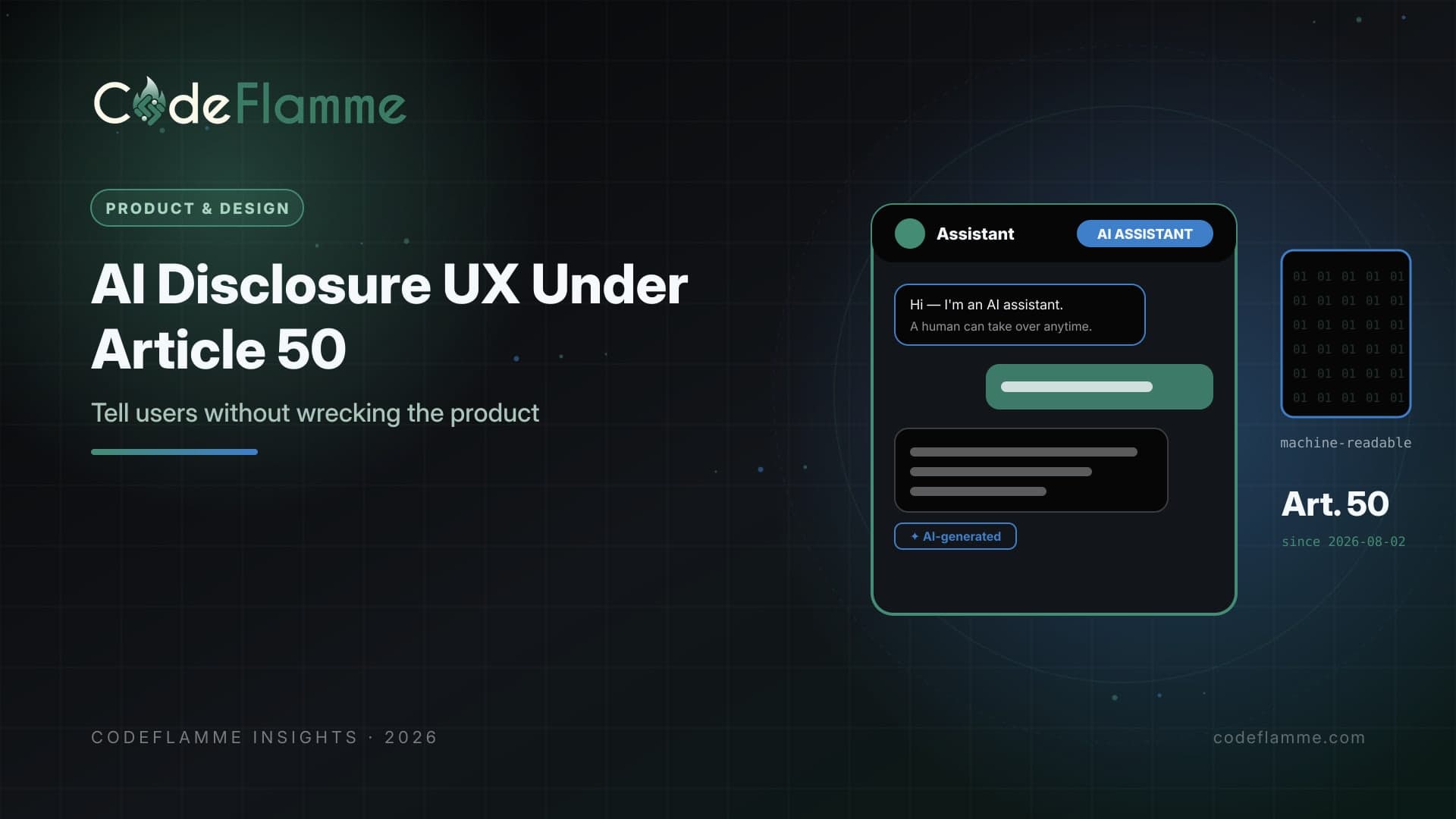
On August 2, 2026, the EU AI Act's transparency obligations under Article 50 became generally applicable and enforceable. They were not delayed by the AI Omnibus, which instead pushed the high-risk system rules to December 2, 2027. If your product talks to users through a chatbot or assistant, or generates text, images, audio, or video, these duties apply regardless of risk classification. Law firm Goodwin notes that non-compliance can lead to fines of up to €15 million or 3% of worldwide annual turnover, whichever is higher. Legal teams will interpret the scope. Product teams have to make it real on screen. Done badly, disclosure becomes another banner users dismiss. Done well, it builds the trust that makes people willing to use AI features at all.
What Article 50 asks the interface to do
Providers of AI systems that interact directly with people must ensure users are informed they are interacting with an AI system, unless that is obvious to a reasonably well-informed, observant, and circumspect person given the context. Providers of systems generating synthetic audio, image, video, or text must mark outputs in a machine-readable format detectable as AI-generated. Deployers must disclose deepfakes, and AI-generated text published to inform the public on matters of public interest, unless it has undergone human review with someone holding editorial responsibility. The information must be clear and distinguishable, given at the latest at first interaction or exposure, and must meet applicable accessibility requirements.
Disclose at the moment it matters
The law sets timing at the first interaction or exposure, which maps neatly onto good UX. Put the disclosure where the conversation starts: in the assistant's header, in its first message, or next to the input field, not in a terms page or an onboarding slide users skip. For voice agents, say it in the opening line. For assistants that handle a support conversation after a human hands off, or vice versa, make the switch explicit so users always know who, or what, they are talking to.
Do not rely on “obvious from context”
The exemption for cases where AI interaction is obvious is real but narrow, and it is judged from the user's perspective, not the product team's. An assistant with a human name and avatar in a support widget is exactly where users get confused. Default to explicit, lightweight disclosure: a persistent label such as “AI assistant” plus a one-line explanation available on tap. It costs a few pixels and removes an argument you do not want to have with a regulator or an enterprise customer.
Disclosure component spec (assistant surfaces)
- persistent label: AI assistant (visible in header)
- first message: states it is AI + what it can do
- info affordance: how it works, data use, human handoff
- handoff events: explicit AI -> human / human -> AI notice
- a11y: label exposed to screen readers, not image-only
- locale: translated for every supported EU language
Label generated content without clutter
For features that generate documents, images, or summaries, combine two layers. The visible layer is a small, consistent indicator, such as an icon with an accessible text label, on generated output and in exports where appropriate. The invisible layer is machine-readable marking, such as metadata or watermarking supplied by your model provider or added in your pipeline. The Commission adopted guidelines on Article 50 transparency obligations on July 20, 2026, so align your approach with them and with your providers' marking capabilities.
Mind the December 2 deadline for legacy systems
The AI Omnibus gave providers of generative systems placed on the EU market before August 2, 2026 until December 2, 2026 to comply with the machine-readable marking obligation. If your generative feature launched before August, that is your deadline. Ask your model and media vendors now what marking they provide, how it survives your export formats, and whether stripping metadata in your image or PDF pipeline undoes it. Many teams accidentally remove provenance data during compression or resizing.
Make disclosure accessible and localized
Because the information must conform to accessibility requirements, an AI badge rendered only as an image or color fails twice. Expose labels to screen readers, make sure contrast works in light and dark themes, and keep disclosure text in plain language. Translate it for every EU market you serve; a German user should not meet an English-only disclosure in an otherwise localized product. Add these checks to your design system so every new AI surface inherits them.
Disclosure for AI agents that act
Agents that send emails, update records, or message customers on a user's behalf raise a second disclosure question: does the recipient know an AI wrote or sent it? Decide per surface whether outbound content generated by your agent carries a label, and give customers admin controls where their own policies require it. Log which messages were AI-generated so customers can answer their own audits. These choices are easier to make in design reviews than after a complaint.
Test disclosure with real users
Add disclosure comprehension to usability testing. After a short session with your assistant, ask participants whether they were talking to a person or software and how they knew. If people cannot answer confidently, the disclosure is not clear and distinguishable, whatever the spec says. Quick tests like this give your legal team evidence and your designers a concrete target.
Founder takeaway
Article 50 is in force. Treat it as a design system problem: a persistent, accessible AI label and first-message disclosure for assistants, consistent indicators plus machine-readable marking for generated content, explicit handoff notices, localization, and a plan for the December 2, 2026 marking deadline if your generative features predate August. Good disclosure is small, clear, and consistent, and it makes users more willing to trust what your AI produces.