
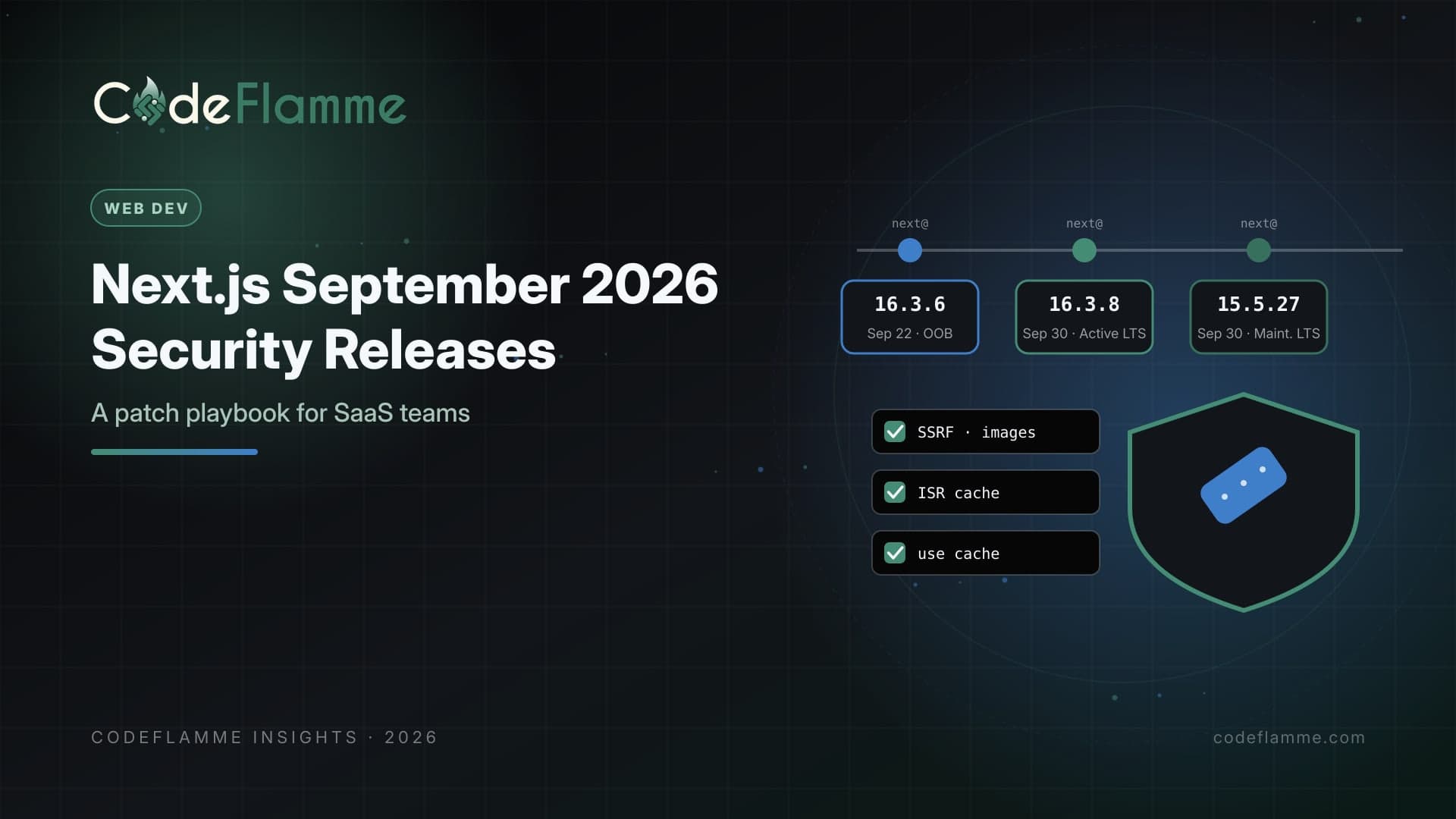
September 2026 was a busy month for anyone running Next.js in production. On September 22, the Next.js team shipped 16.3.6 and 15.5.26 as an out-of-band update for a critical issue in an upstream dependency. A week later, on September 30, the scheduled security release landed as 16.3.8 on the Active LTS line and 15.5.27 on the Maintenance LTS line, closing advisories that ranged from a high-severity server-side request forgery in Image Optimization to several cache-poisoning and cache-leak issues. For a SaaS founder, the headline is not any single CVE. It is that Next.js now announces security releases in advance and ships them on a schedule. Teams that can patch within days get the benefit of that predictability. Teams that need three weeks of manual QA to bump a minor version carry the risk the whole time.
Triage by how you deploy, not by severity alone
The September 30 advisories are a good lesson in reading the fine print. The Image Optimization SSRF only affects apps that configure images.remotePatterns ; if you never allow remote images, you are not exposed to that one. The Pages Router SSG/ISR cache-poisoning issue affects self-hosted deployments, and the advisory states that apps deployed on Vercel are not affected. The metadata image route bypass applies to App Router apps built with webpack, not Turbopack. Two issues involve Cache Components and 'use cache' , one of them leaking Draft Mode content into regular responses. Your exposure depends on your router, bundler, hosting, and caching choices.
Patch first, investigate second
Triage tells you how urgent the fix is, but for supported lines the answer is almost always to upgrade. Moving within 16.3.x or 15.5.x is a patch-level change designed to be low risk. Bump the version, run your test suite and a smoke pass on the flows customers touch most, and ship. If you are on an older major that is no longer listed as Active or Maintenance LTS, the real issue is not this release; it is that you are outside the support window and future fixes may not reach you at all.
# Supported lines after the September 30, 2026 release
npm install next@16.3.8   # Active LTS
npm install next@15.5.27  # Maintenance LTS

# Then verify what actually shipped
npx next --version
npm ls next
Self-hosting raises the stakes
Several September issues targeted shared caches: a crafted request could replace a cached page with content from another route, or poison a shared response cache so every visitor sees the wrong content until revalidation. Self-hosted SaaS teams own that cache layer, so after patching, purge or revalidate statically generated pages that might have been poisoned, review CDN cache keys, and confirm your monitoring would notice a page suddenly serving the wrong content. A cache that silently serves one customer's view to another is a trust incident, not just a bug.
Treat the dev server as an attack surface
One low-severity advisory covered the development server's Model Context Protocol endpoint, which did not check the origin of requests. A malicious website visited by a developer could read project paths, source snippets from error reports, the route inventory, and dev logs. Production deployments do not serve that endpoint, but the lesson matters as more tooling exposes local endpoints for AI assistants. Keep local tooling patched like production dependencies, and include developer machines in your security story when enterprise buyers ask.
Build a patch lane, not a fire drill
The predictable cadence is only useful if your pipeline can absorb it. A practical patch lane for a SaaS product looks like this: Dependabot or Renovate opens the upgrade PR automatically; CI runs unit, integration, and a short set of end-to-end tests on critical journeys such as login, billing, and the main dashboard; a preview deployment lets someone click through in five minutes; and the merge goes out behind your normal progressive rollout. When advance notice arrives, you schedule a slot for release day instead of scrambling.
What to tell customers
Enterprise customers increasingly ask how fast you patch framework vulnerabilities. Have an honest answer: your target time to patch for critical and high advisories, how you track framework releases, and evidence from the last cycle. Being able to say you were on 16.3.8 within a day or two of September 30, with a record of the triage, is a strong answer in a security review. Avoid claiming you were never affected unless you checked each advisory against your configuration.
Reduce your surface over time
Every framework feature you enable is code that can carry a vulnerability. That does not mean avoiding features, but it does mean pruning ones you do not use. If you allow remote images from a dozen hosts but only need two, tighten remotePatterns . If Draft Mode exists for a CMS integration nobody uses, remove it. If you experimented with Cache Components and left it half-enabled, either finish the adoption with tests around tenant- and param-specific cache keys or roll it back. Fewer features in play means fewer advisories that apply to you.
Assign an owner for framework advisories
Advance notices only help if someone reads them. Name one engineer, rotating monthly if you like, who watches the Next.js blog and GitHub security advisories, files the triage note against your surface record, and books the upgrade slot. In a small team this takes an hour a month. Without an owner, the September 23 announcement sits in someone's feed until a customer's scanner flags the old version for you.
Founder takeaway
The September 2026 releases are a reminder that framework security is an operational capability. Know your deployment surface, patch supported lines quickly, clean up caches when advisories touch them, stay inside the LTS window, and turn advance notices into scheduled work. Teams that do this treat security releases as a routine Tuesday task. Teams that do not end up explaining to a customer why a known fix sat unmerged for a month.