Since 2022, health plans have published enormous machine-readable files of negotiated rates and out-of-network allowed amounts. An industry of startups grew up around them: price comparison tools, employer analytics, benefits navigation, and data platforms that tame files measured in terabytes. On October 5, 2026, the Departments of Health and Human Services, Labor, and the Treasury finalized changes to the Transparency in Coverage rules that reshape those files. The final rules were published in the Federal Register on October 6 and are effective December 7, 2026. If you build software that produces these files for plans, or consumes them for customers, your roadmap just got new dates.
What changes in the machine-readable files
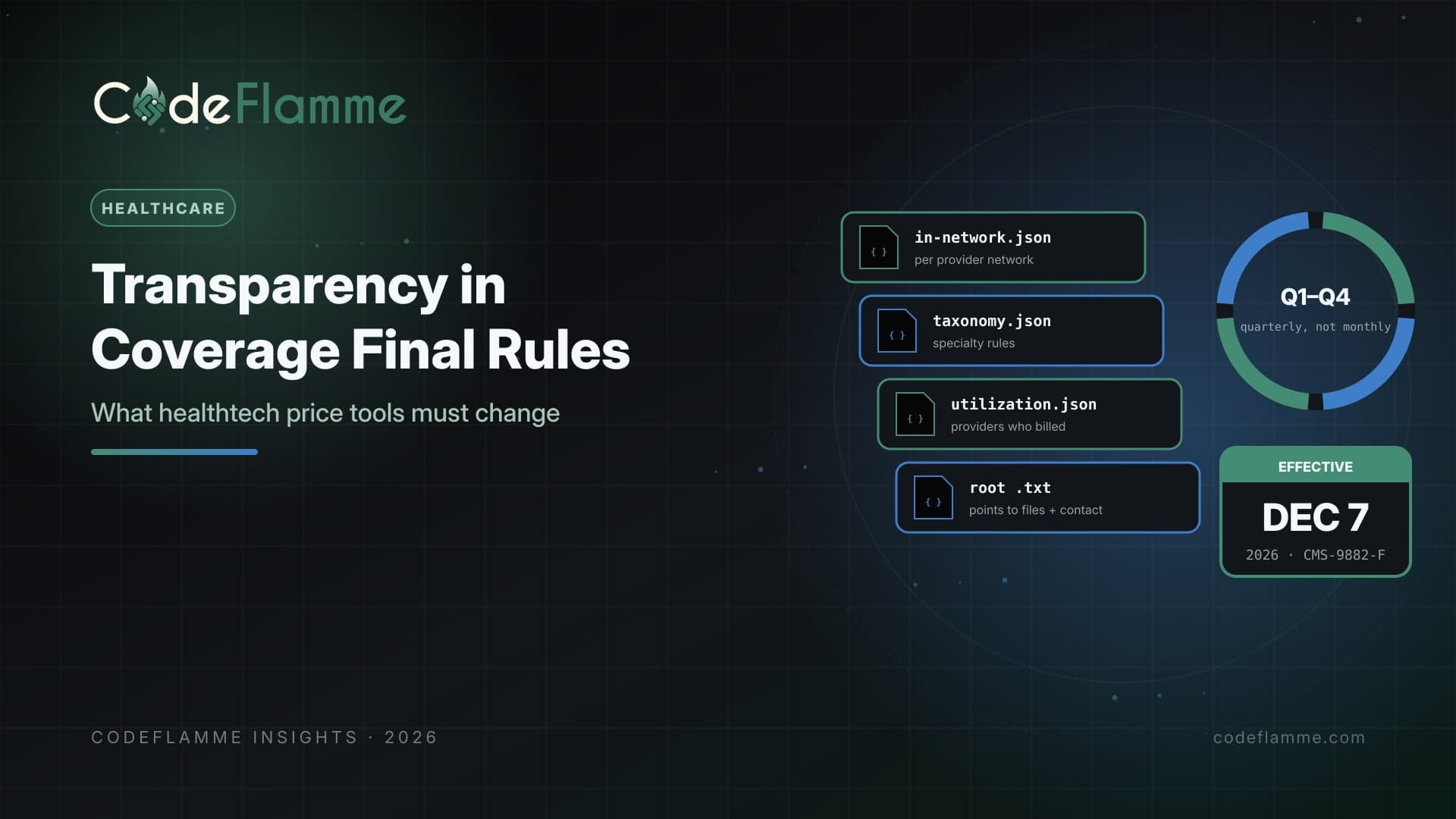
Network-level in-network rate files. Plans and issuers must publish one In-network Rate File per provider network they maintain or contract with, rather than one per plan or policy. Each file must report the common network name and a provider network identifier, and files must identify the product type, such as HMO or PPO, for the plans represented. Fewer impossible rates. Plans must exclude provider-rate combinations for services a provider would be unlikely to be reimbursed for given their specialty, using their internal taxonomies or claims rules, and publish those rules in a new Taxonomy File . A new Utilization File lists providers who actually submitted and were reimbursed for at least one claim in the relevant period. More out-of-network data. Allowed Amount Files are aggregated by market type (large group, small group, individual, and self-insured), the claims threshold drops from 20 to 11, and the reporting period lengthens. Quarterly, single-format, findable. Rate and allowed-amount files move from monthly to quarterly updates. The Departments intend to specify JSON for all files other than a new plain-text file placed in the root of the plan's website that points to the files and lists a monitored contact email. Plan homepages need a footer link titled "Price Transparency" or "Transparency in Coverage." Attestation. Each file must include an attestation of completeness and accuracy and the name of a senior official designated to oversee the data.
The dates that matter
The rules are effective December 7, 2026. According to the CMS fact sheet, the amendments to the in-network rate and allowed-amount files apply five months after publication, which lands around early March 2027. The new contextual files, meaning taxonomy, utilization, and the text file, apply eleven months after publication, around early September 2027. The requirement to provide personalized cost-sharing estimates by phone, in addition to the online tool and paper, applies for plan years beginning on or after January 1, 2027. Separately, the Departments plan to begin developing the prescription drug file schema in November 2026, finalize it around May 2027, and expect plans to publish those files starting December 2027, monthly thereafter.
If you produce files for plans
TPAs, issuers, and the vendors who generate files on their behalf need to rebuild around networks: define what counts as a distinct network, including leased or derived networks, assign stable network identifiers, and map every plan to its networks. Build the specialty-based exclusion logic from the same rules used in claims adjudication, then generate the taxonomy and utilization files from that logic so they cannot drift. Add attestation fields to your file generation workflow with a real sign-off step, because a named executive is now encoded in the data.
If you consume files
Price-transparency platforms and cost tools should plan for a transition period where some payers publish old-format monthly files and others publish new network-level quarterly files. Use the root text file for discovery once it appears, model networks as first-class entities keyed by identifier rather than name, and use the utilization file to filter rates to providers who actually bill for a service. Quarterly cadence also means you can stop re-ingesting unchanged data every month, which may lower storage and compute costs.
# Illustrative ingestion model after the 2026 TiC final rules
entities:
  network:   { key: network_id, fields: [common_name, payer, product_types] }
  plan:      { key: plan_id, fields: [market_type, networks] }  # via table of contents
  rate:      { key: [network_id, billing_code, npi], fields: [negotiated_rate] }
  utilization: { key: [network_id, npi], fields: [period] }
schedule:
  in_network_and_allowed_amounts: quarterly
  discovery: root_text_file   # contact email + file locations
validation:
  require_attestation_fields: true
  drop_rates_without_utilization: configurable
Phone-based estimates are a product opportunity
The rule requires plans to provide the same cost-sharing information by phone, upon request, using the customer service number on the member ID card. The Departments note plans may limit phone and paper disclosures to no fewer than 20 providers per day each. For vendors who already power online estimator tools, an agent-facing interface for call centers, with the same data and disclaimers, is a natural extension.
Watch for technical guidance
Many implementation details, including how to report network hierarchies, how plans without existing network identifiers should report them, and the next schema version, will come through technical implementation guidance and the Departments' GitHub process. Assign someone to follow those updates and translate them into tickets. Teams that track the guidance as it lands will spend far less time on rework than teams that wait for a complete specification.
Founder takeaway
These rules make price data smaller, more contextual, and more accountable, and they force real engineering work on both sides. Producers should design network definitions and exclusion logic before the March 2027 application date. Consumers should remodel around networks and plan for mixed formats. Everyone serving plans should treat phone-based estimates as a January 2027 deliverable.