Managed backends — auth, datastore, file storage, realtime — help healthtech teams prove workflows before they hire a platform army. They also create sharp edges when workflows touch protected health information. This article is product-engineering guidance for founders building early systems. It is not legal advice, not clinical advice, and not a certification promise. Involve qualified counsel and compliance partners for your jurisdiction and buyers.
Name what data you are actually handling
Teams blur “health-adjacent” and regulated PHI. Be explicit in architecture docs: identifiers, clinical content, device signals, billing artifacts, and whether you are a vendor to covered entities. Classification drives hosting, BAAs, access logging, and whether a consumer BaaS project is even in bounds. If you do not know, pause feature work and decide — guessing is how MVPs become migration emergencies mid-pilot.
BaaS strengths for early healthtech
Auth, rapid CRUD, file uploads, and realtime coordination can validate care-coordination UX, ops tooling, or patient engagement prototypes quickly. Use them where data classification allows, or where you have confirmed the vendor relationship and configuration meet your program’s requirements. Prefer patterns that keep least privilege in security rules / RLS from day one — “open for demo” rules have a way of surviving into staging copies of real data.
Boundary patterns founders should demand
Common engineering patterns: isolate environments; never use production-like PHI in personal projects; encrypt sensitive fields at application level when appropriate; minimize data in clients; avoid putting unrestricted secrets in shipped mobile apps; turn on robust audit logs; and design an exit — export and delete paths — before volume grows. If some workloads need a harder boundary, split: BaaS for non-PHI orchestration, specialized stores for sensitive payloads, with clear APIs between them. Mobile offline caches and push payloads are frequent leakage points. Review what is queued on device and what notification bodies contain.
Buyers will ask process questions
Hospital IT and security will ask about BAAs, subprocessors, access control, encryption, logging, incident response, and workforce access. Your engineering choices should make truthful answers possible. “We’re on a popular BaaS” is incomplete without configuration evidence and data-flow diagrams. Practice the walkthrough with a one-page diagram: client → APIs → stores → vendors.
When to graduate
Signals you are outgrowing the MVP shape: enterprise BAAs your current stack cannot support; residency requirements; complex clinical integrations; or audit needs that fight the platform’s defaults. Plan migrations while traffic is small. Waiting until a flagship pilot lands is how timelines slip into breach-of-trust territory with champions.
Security rules and RLS as product code
Treat security rules / row-level policies like production code: review, test, and stage. Add automated tests that attempt cross-tenant reads. Log denials. Never rely solely on “obscure collection names.” Client-exposed APIs will be probed. Separate privileged admin SDKs from client configs. Build pipelines should not embed service-account powers in mobile binaries.
Observability without over-collection
Support needs logs; compliance needs minimization. Prefer tokenized identifiers in logs, careful field scrubbing, and retention limits. Product analytics on clinical screens may be inappropriate — decide deliberately. Document what is collected for engineering vs what is stored as product data.
Pilot readiness checklist
Before a clinical or hospital-adjacent pilot: data-flow diagram; vendor list + contracts posture; access control tests; incident contacts; backup/export drill; pen-test or structured review appropriate to stage; and a written “what we will not store yet” list. Ambition is good. Unscoped PHI in a toy project is not.
Mobile and edge realities
Ship with certificate pinning decisions documented, jailbreak/root soft signals where appropriate to your threat model, and remote config to disable sensitive modules. Offline encrypted stores need key management stories. Push notifications should avoid PHI in clear text payloads — use opaque ids and fetch in-app under auth.
Vendor roadmap risk
Managed platforms change pricing, regions, and compliance offerings. Track their roadmap against your pilot promises. Dual-run critical exports monthly so a forced migration is boring. Contractual clarity beats Twitter rumors — but engineering exit drills beat both.
Team access and workforce training
Limit who can open production projects. Use separate accounts for PHI-capable environments. Train staff that support screenshots and CSV exports are controlled events. MVP culture (“everyone has admin”) is incompatible with later diligence — fix access while the team is small.
Example boundary diagram in words
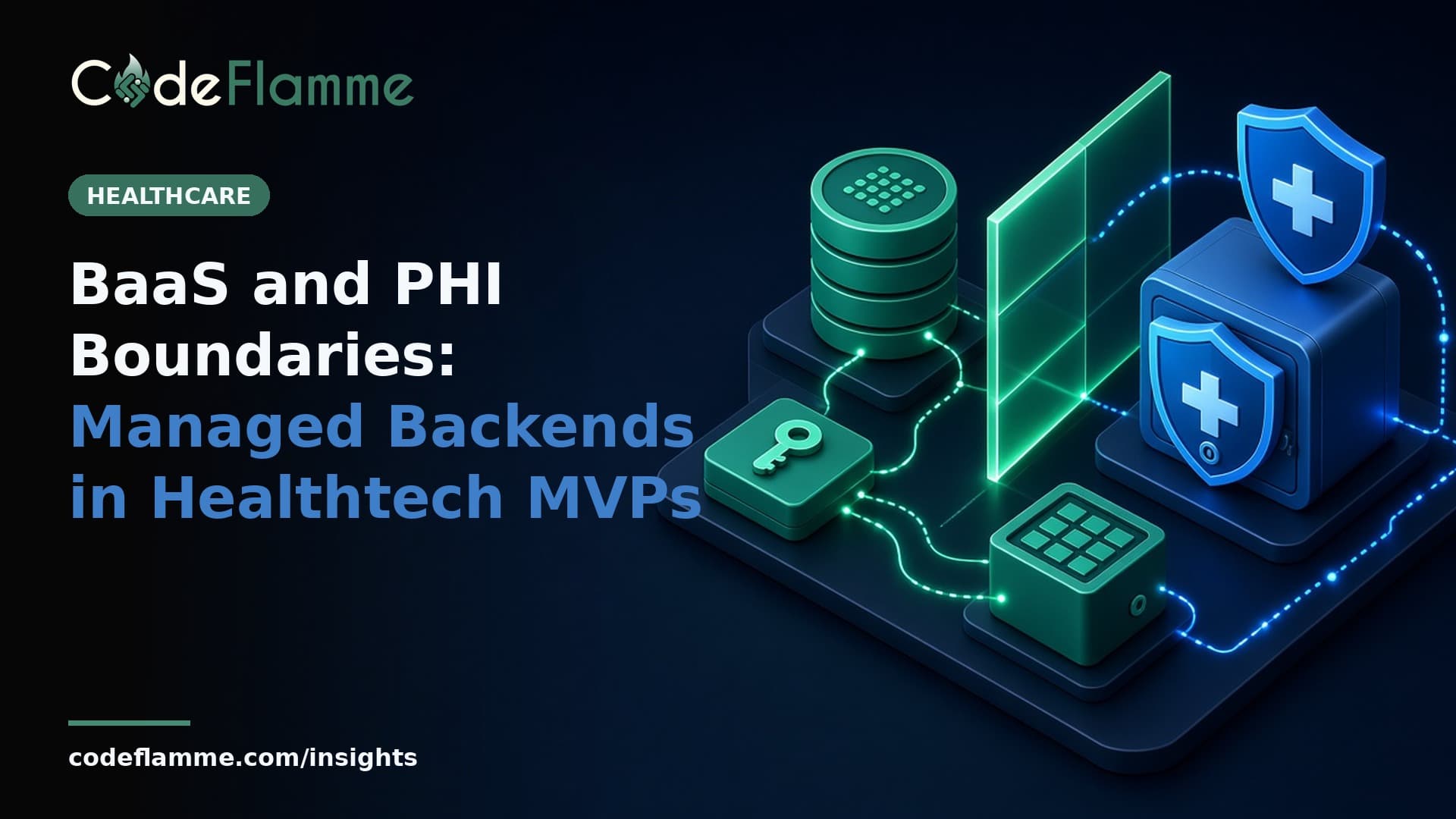
Client apps talk to your API gateway; gateway enforces authn/z; non-sensitive collaboration features may use managed realtime/store A under strict rules; sensitive payloads land in store B with tighter controls and fewer staff admins; files go through scanned upload paths; subprocessors listed for buyers. Even a napkin version beats an undifferentiated “everything in one project” MVP when diligence starts.
What to tell early design partners
Be transparent about stage: which data classes you accept now, which integrations wait, and how wipe/export works if the pilot ends. Partners forgive early architecture when honesty and controls are clear; they do not forgive surprises about where sensitive data lived.
Founder takeaway
Managed backends can accelerate healthtech learning loops when data classification, contracts, and security rules are intentional. Draw PHI boundaries early, document flows, and keep an exit ramp. Pair product velocity with compliance partners — engineering patterns alone do not create regulatory clearance.
Related reading
For the wider picture, read how to build a healthtech MVP without getting burned by compliance , what to build now while the HIPAA Security Rule is in limbo , and how to budget FHIR and EHR integrations before the demo . Not sure where your PHI boundary should sit? Talk to the CodeFlamme team .