Founders hiring an agency for a B2B SaaS MVP usually treat authentication as a two-week ticket. It is not. The login form is the easy 10%. The other 90% is email verification, password reset abuse, MFA enrollment, organization membership, invite and revoke flows, session revocation after role changes, audit trails for security questionnaires, and the first enterprise customer who will not sign until SSO works. This is a practical build-vs-buy brief for founders scoping auth with an agency in 2026: when managed auth is the default, how Clerk-class products differ from Auth0-class platforms and SSO overlays, when custom is defensible, and how to keep authorization and tenant records in your own database either way — so you are not locked into a vendor UI forever.
Buy is the default — with a clear adapter
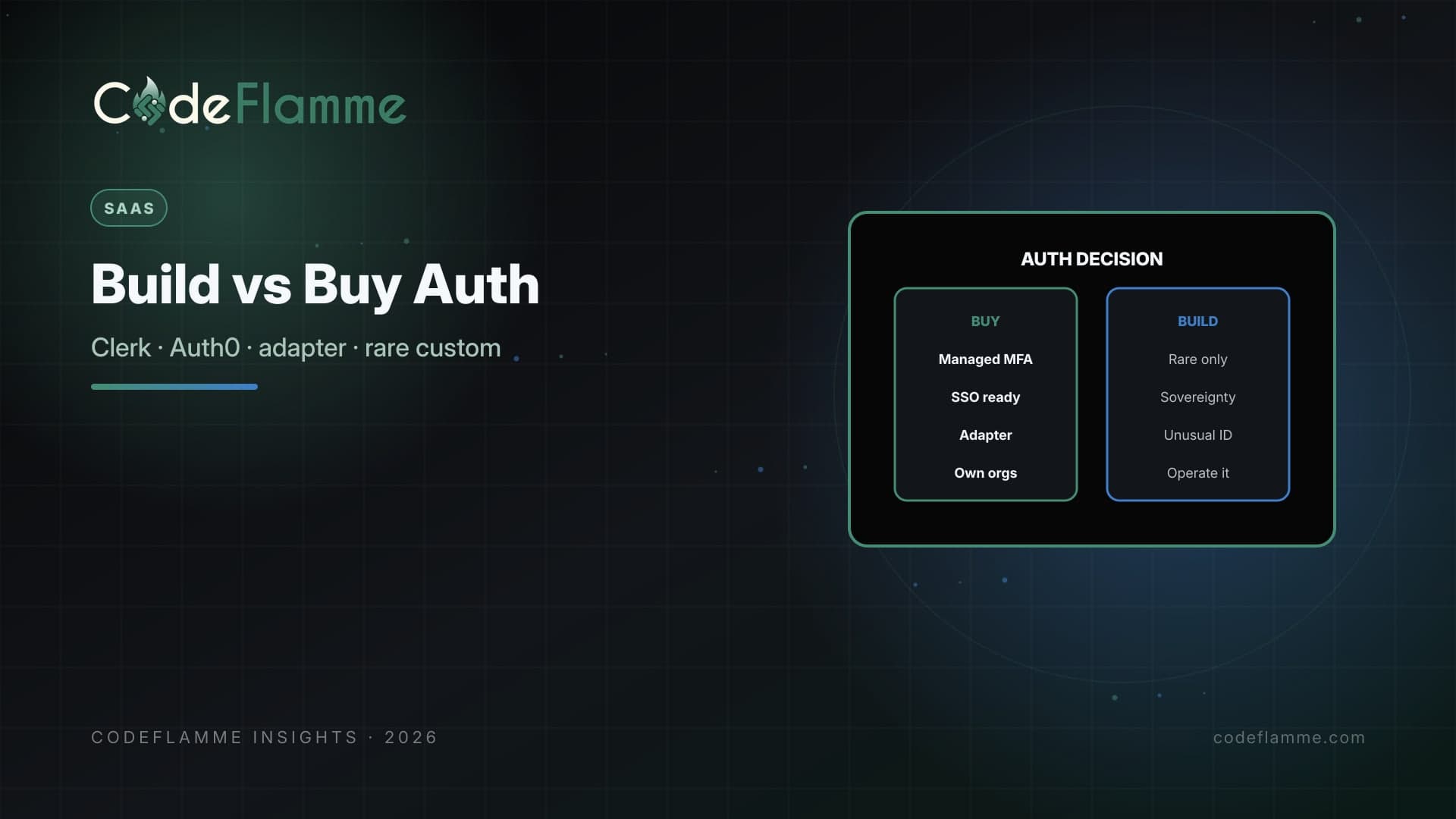
Independent build-vs-buy writeups in 2026 still land the same way: buy a managed provider for anything user-facing unless a hard constraint rules it out. Managed auth ships MFA, social login, passkeys, recovery flows, and a compliance posture you would otherwise staff and audit yourself ( Clerk on the real cost of rolling your own ; 2026 Auth0 vs Clerk vs custom overview ). Whatever you buy, hide it behind a thin adapter. Keep users (or user links), organizations, roles, and entitlements in your database. The agency should deliver working sign-in plus a documented identity-to-tenant mapping and logout/revoke behavior — not a product that can only query the vendor's user object for every permission check. That adapter is also your escape hatch. If enterprise pricing or protocol needs force a later move, you migrate sessions and identifiers once; you do not rewrite billing, admin, and every API that checked "isAdmin" against a vendor SDK.
Clerk, Auth0, overlays — how founders should choose
Clerk is a strong default for React/Next.js B2B products that want organized workspaces, polished UI components, and fast time-to-staging. Brief the honest trade-offs: enterprise pricing is often custom, deep UI beyond theming means hooks and custom flows, and you should still own the org membership model in your app data. Auth0 and similar full CIAM platforms earn their place when protocol breadth, complex policies, Actions/rules pipelines, or mixed B2C/B2B identity drive the deal. You are buying configuration power and mature enterprise SSO depth — and accepting more product surface for your team (or agency) to operate. Do not pick Auth0 only because a sales engineer said "enterprise" without naming the protocols you need. SSO overlays (WorkOS-class brokers) matter when core auth already works and the blocker is "our enterprise customer needs SAML/OIDC and SCIM next month." Overlays add connections without a full identity migration. Brief your agency on whether you are replacing login or only adding enterprise connections — those are different statements of work and different failure modes.
When custom auth is defensible (rarely)
Custom is not "we can ship bcrypt in a weekend." It is defensible when regulation or sovereignty forbids the managed options you can actually buy, when your identity model is genuinely unusual, or when you already run a mature identity service with a security mandate and budget to operate it. Even then, prefer buying MFA, passkeys, and recovery components over inventing them from blog posts. If an agency pitches custom auth to "save license fees" on a seed MVP, ask for the cost of password-reset abuse handling, session-theft response, breach notification readiness, and the first SSO customer. That conversation usually returns you to managed auth with an adapter — and a smaller security surface for the agency to get wrong.
What to demand in the agency kickoff
Require concrete acceptance tests early: staging sign-up, sign-in, reset, and MFA (or a dated plan for MFA) within the first foundation milestone; org invite plus at least owner/member roles documented; webhook or equivalent handling for the user lifecycle events you care about; a written escape hatch for exporting users and rotating sessions if you change vendors; authorization tests that do not depend on the vendor's hosted UI. Defer SCIM and multi-IdP SSO until a named enterprise deal needs them, unless your ICP is enterprise-only from day one. Passkeys and SSO can coexist with passwords; treat them as rollout phases, not a big-bang rewrite of login week three. Align auth choices with billing identity (Stripe Customer linkage) so seats and subscriptions do not drift from org membership.
Budget language that keeps scope honest
Price auth as a foundation milestone with acceptance tests, not as a vague "include login" line. Separate core auth from the first enterprise SSO connection. Refuse vanity estimates that assume zero security review and zero questionnaire support. Ask for ranges tied to the Must column only, with SSO and SCIM as named options. CodeFlamme briefs founders this way so agency weeks go into the product workflow customers pay for — not into reinventing sessions. If you want help choosing a provider and writing the adapter boundary into an SOW before kickoff, that is exactly the kind of discovery we run before build weeks start.
Related reading: if SSO is already on a buyer's checklist, see our guide to rolling out passkeys alongside SSO and passwords in B2B SaaS . When you price the auth milestone with an agency, our breakdown of fixed-price vs milestone billing helps you tie payment to acceptance tests. And if your product runs on Next.js, read our Next.js 16.4 Cache Components plan so auth-gated pages are not cached by mistake. Want a second opinion on your auth plan? Talk to the CodeFlamme team .