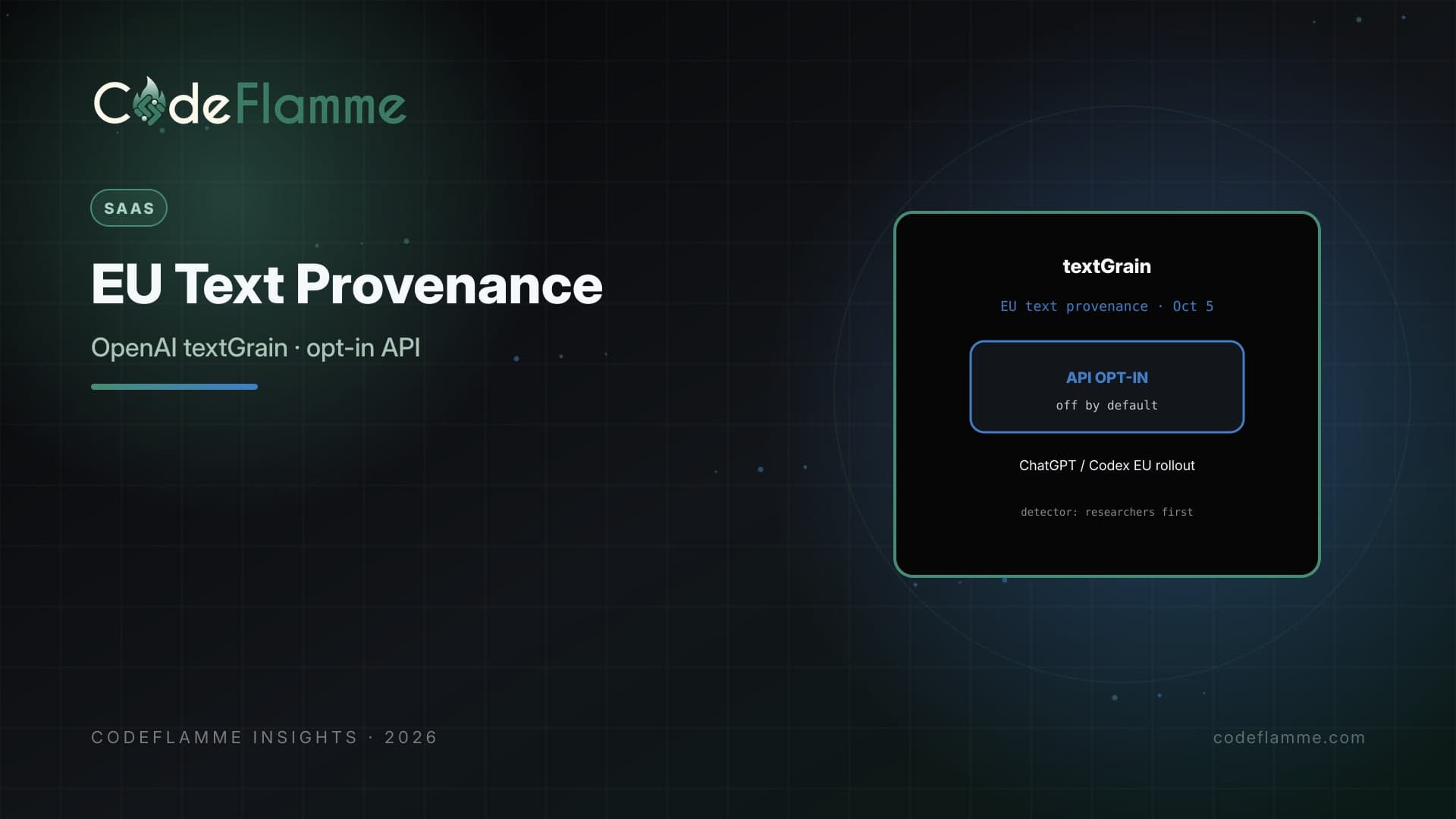
On October 5, 2026, OpenAI published "Our approach to EU text provenance rules." Under the EU AI Act, generative AI providers must make machine-readable provenance available for generated text. OpenAI's phased plan: API customers worldwide can opt in to text watermarking for select models, remaining off by default; over the coming weeks, eligible ChatGPT and Codex text output in the European Union will carry an invisible watermark; detector access opens first to approved researchers and expert organizations, not the general public. If your SaaS calls OpenAI models to draft emails, tickets, knowledge-base articles, or agent replies for EU users, you now have product and legal questions that are not answered by "we use GPT." Watermarking is opt-in on the API — silence is a decision.
What textGrain is — and what OpenAI says it is not
OpenAI's textGrain technology adds an invisible statistical signal to word choices; a detector estimates whether a passage contains that signal. OpenAI is explicit about limits: shorter or constrained text (for example mathematics) is harder to detect; editing and synonym replacement weaken the signal sharply; a watermark does not measure human contribution, establish ownership, identify the user, or verify accuracy; absence of a watermark does not prove human authorship. Those caveats matter for SaaS marketing. Do not promise customers "we can prove every AI sentence" if you only toggle an upstream watermark. Pair provenance signals with your own disclosure UX and audit logs.
Decisions for B2B product teams this month
Map surfaces. Which features emit OpenAI-generated text to EU end users versus internal copilots? Public help centers and customer emails are different risk than a private admin draft box. Opt-in policy. Decide whether production EU traffic enables watermarking where the API allows it. Coordinate with counsel on whether your role is provider, deployer, or both under the AI Act — this post is not legal advice; it is an engineering checklist trigger. Disclosure UX. Watermarks are not a substitute for user-facing AI disclosure where Article 50-style transparency applies to your chatbot. Keep the disclosure pattern you already ship; treat provenance as an additional layer. Editing pipelines. If humans heavily edit model output before publish, say so in policy. OpenAI's own evals show modest edits crush detection rates — buyers who demand "detectable AI" need honest limits. Vendor matrix. Claude, Gemini, and open-weight stacks will not share one watermark. Multi-model routers need a provenance story per provider, plus your own content credentials where you generate images/audio.
EU text provenance SaaS checklist (OpenAI 2026-10-05)
[ ] Inventory features that call OpenAI for EU-visible text
[ ] Decide API watermark opt-in per environment / model
[ ] Update DPA / AI annex language with counsel (limits of detection)
[ ] Keep user-facing AI disclosure separate from watermark flags
[ ] Log model, watermark setting, and prompt version on generations
[ ] Train support: "no watermark ≠ human-written"
Founder takeaway
OpenAI's October 5, 2026 EU text provenance approach makes watermarking an explicit API choice and starts EU ChatGPT/Codex watermark rollouts while limiting detectors to vetted researchers. B2B SaaS should inventory EU-facing generation, decide opt-in settings, keep disclosure UX honest about detection limits, and stop treating provenance as a checkbox your model vendor fully owns.
How to talk about this without overclaiming
OpenAI's post is careful: watermarks are limited signals, detectors err, and editing destroys evidence. Your sales deck should borrow that humility. Replace "AI-proof content" with "optional upstream watermarking where supported, plus our disclosure and logging." Regulators and journalists will compare your claims to the primary OpenAI page. If you fine-tune or heavily post-process, ask counsel whether your pipeline still qualifies for the provider's watermark and whether you have separate transparency duties as a deployer. Engineering should expose a per-request flag for watermark mode so compliance can audit environments.
Codex and ChatGPT EU rollouts affect employees as well as products. Developer tools generating code comments or PR descriptions in the EU may carry watermarks soon; update internal AI-use policies so staff understand what that does and does not prove in IP disputes.
Multi-provider reality
Most B2B stacks already route across OpenAI, Anthropic, Google, and open weights. Build an abstraction that records provider , model , provenanceMode , and disclosureShown on every generation. When a customer asks "was this AI?", you answer from your logs — not from a public detector you cannot access.
Schedule a 30-day review after you change opt-in settings: measure support tickets, enterprise FAQ hits, and whether editors disable watermarking locally. Provenance without change-management becomes a silent config nobody owns.
What to do in the next two weeks
Put an owner on the checklist in this article, schedule the verification work, and write down what "done" means in your ticketing system. Share the primary-source links with security and counsel so debates start from the vendor or regulator text, not from a slide paraphrase. If you need external help, bring them the inventory — versions, hosts, and current configs — not a blank calendar invite.
Close the loop with a short internal note: what changed, what remains open, and which customer communications went out. That note becomes the seed of your next audit response and keeps the organization from relearning the same lesson next KEV wave.
Engineering rollout sequence
Start in a non-production project with one EU-facing generation endpoint. Enable watermark opt-in for a single model, log the setting beside request ids, and have QA compare sample outputs for obvious quality regressions — OpenAI reports little benchmark impact on Astra in their tables, but your domain prompts may differ. Promote to production behind a feature flag scoped by workspace region. Keep a kill switch that disables watermarking if a provider incident or customer contract requires it, and record who flipped the switch. Update your subprocessor and model inventory sheets the same day. Enterprise customers comparing AI annexes will notice if provenance language appears in the blog but not in the trust center.