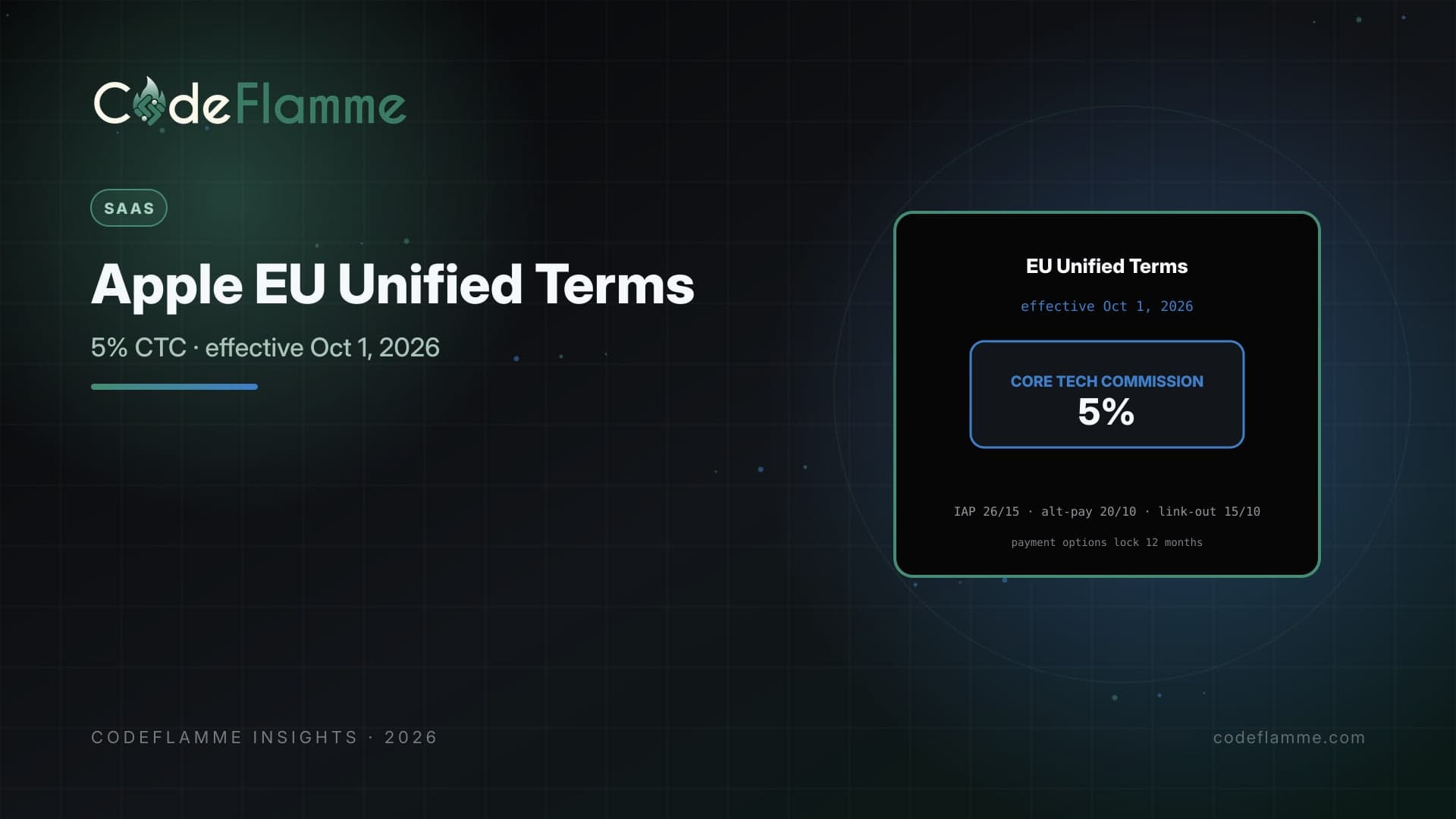
On August 18, 2026 Apple announced unified business terms for apps distributed in the European Union, with changes effective October 1, 2026. That date has already landed. If your SaaS sells digital goods or subscriptions to EU users through iOS — App Store, alternative marketplace, or web distribution — you should assume the new Attachment 14 world applies once the account accepted the updated Apple Developer Program License Agreement. The headline economics: the Core Technology Fee (per-install at extraordinary scale) is replaced by the Core Technology Commission — a 5% commission on digital transactions in apps distributed outside the App Store. Initial acquisition and store services fees under the old alternative-terms regime are eliminated. Commission rates across IAP, alternative payment processing, and link-out were reset in the same announcement.
Commission map you should brief finance on
From Apple's newsroom summary under the unified terms: App Store + Apple IAP: 26% standard; 15% for Small Business / Mini Apps / Video Partner programs and for auto-renewing subscriptions after the first year. App Store + alternative payment processing: 20% standard; 10% for those reduced programs. App Store + link-out to complete purchase: 15% standard; 10% reduced. Alternative app marketplaces or web distribution: 5% Core Technology Commission. Those percentages are Apple's published figures — use them in finance models as cited, and verify against the current developer support tables before you sign customer pricing addenda.
Product changes that are not optional
Accept the updated license. Developer support pages state that moving to unified EU terms requires agreeing to the updated Apple Developer Program License Agreement; older Alternative Terms / StoreKit External Purchase Link addenda are superseded as of October 1, 2026. Offer IAP alongside alternatives when you choose to. Apple now permits alternative payments alongside IAP in EU storefronts, with presentation requirements for a consistent user experience. Child-safety gates. Kids-category apps cannot link out for transactions. Users under 18 need a parental gate for alternative processing or link-out; users under 13 cannot link out at all. Member-state rules that raise the parental-consent age scale accordingly. Notarization still applies for alternatively distributed apps, including web distribution.
EU iOS SaaS checklist (post Oct 1, 2026)
[ ] Developer account on updated license / Attachment 14
[ ] Finance model updated for IAP 26/15, alt-pay 20/10, link-out 15/10, CTC 5%
[ ] Chosen payment options documented; 12-month lock acknowledged
[ ] StoreKit / link-out / alt-processor UX reviewed for Apple presentation rules
[ ] Parental-gate flows tested for under-18 paths
[ ] Customer contracts: EU price / tax / refund language updated
[ ] If web or marketplace distribution: notarization + eligibility path confirmed
Founder takeaway
October 1, 2026 was the switchover to Apple's unified EU terms. Replace CTF planning with CTC 5% for alternatively distributed digital transactions, update commission assumptions for IAP and alternative payments, lock a payment-option strategy for twelve months, and bring legal/finance into the same thread as StoreKit engineering. SaaS teams that treat this as "DMA paperwork" will mis-price EU deals and break checkout mid-quarter.
Contract and pricing work finance owns
Update customer order forms that assumed Core Technology Fee language or older alternative-terms fee stacks. Replace them with CTC 5% where you distribute outside the App Store, and with the correct IAP / alternative-payment / link-out rates when you stay on the store. If you previously marketed "avoid Apple's commission" as a blunt slogan, rewrite it: Apple still charges commissions under the unified model; the structure changed. Tax and invoicing teams need to know which legal entity collects payment for each path. IAP settlements, alternative processors, and web checkout each produce different reports. Align month-end close before marketing launches a dual-path EU promotion.
Eligibility for web and marketplace distribution
Apple expanded who can operate alternative marketplaces or use web distribution — financial stability scoring, public-company ownership, venture funding from established firms, audited financials, or certain institutional statuses. If your growth plan depends on web distribution in the EU, confirm eligibility early and budget notarization lead time. Web distribution without a marketplace operator still carries Apple's notarization baseline for serious threats.
Engineering should inventory StoreKit External Purchase Link entitlements and any dual-implementation payment UI built for the pre-October regime. Presentation requirements for offering IAP beside alternatives are product work, not a one-line config flag. Schedule UX review with legal on parental gates if any SKU can be used by teens.
For B2B SaaS that mostly sells seats on the web and only uses iOS as a companion app, re-validate whether digital goods are even sold in-app. Sometimes the cheapest compliance path is removing in-app digital purchases in the EU and deep-linking to an already-compliant web billing portal — if that matches your chosen, locked payment options.
Operationally, treat this topic as a dated workstream with a named owner, a written success check, and a short note you can reuse in customer security or procurement reviews. Prefer primary sources linked in your engineering channel over secondary summaries. If you cannot point to the advisory, policy table, or vendor post that justifies the change, you are not ready to claim readiness.
Share the plan with support and sales early. The expensive failure mode is not the code change — it is a surprise store rejection, a customer questionnaire gap, or a checkout path that marketing already promoted. A one-page internal brief beats a Slack thread nobody can find a month later.