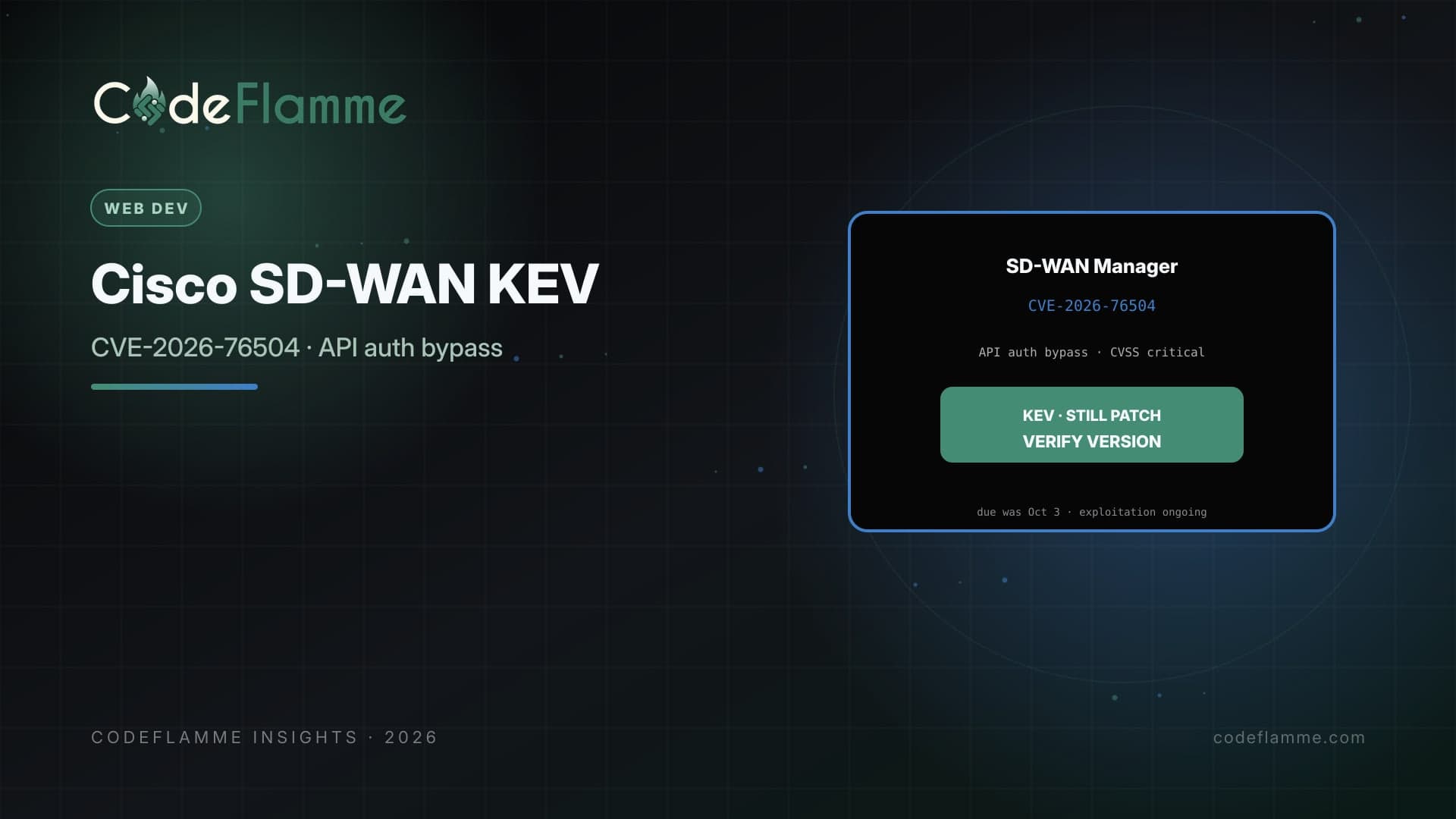
CISA added CVE-2026-76504 to the Known Exploited Vulnerabilities catalog on September 30, 2026, with a federal remediation due date of October 3, 2026. Cisco's advisory describes a critical Catalyst SD-WAN Manager API authentication bypass caused by improper URI/hex encoding: an unauthenticated remote attacker can access the API with administrative privileges. Fixed releases called out in Cisco remediation guidance include builds such as 20.9.10.1, 20.12.8.2, 20.15.6.1, 20.18.4.1, 26.1.2.1, and 26.2.1 (verify against the advisory for your train). Cisco also instructs operators to collect admin-tech logs and work with TAC when compromise review is needed. The federal due date has passed. That does not mean SaaS companies or agencies running Manager for branch connectivity are safe — it means unpatched estates are late on a known-exploited critical. October 11 is a good day to re-check.
Who actually owns this in a SaaS company
SD-WAN Manager is often "network team's problem" until an attacker uses admin API access to rewrite policies, intercept traffic paths, or pivot into cloud interconnects that carry product traffic. Founders should ask: do we run Catalyst SD-WAN Manager anywhere (HQ, colo, customer-managed reference architectures we still support)? Which version string is live? Who patches it within 72 hours of a CVSS 9.8 KEV? If you only consume a carrier-managed SD-WAN, demand written confirmation of the fixed release. "We use Cisco" is not a control.
Practical checklist
1. Inventory Manager instances and internet exposure of the management plane. 2. Match running version to Cisco's fixed list for your train; schedule urgent upgrade windows. 3. Follow Cisco's pre-upgrade log collection; engage TAC if indicators warrant. 4. Rotate credentials and review admin accounts after upgrade. 5. Add Manager version to the same vuln SLA dashboard you use for Kubernetes and IdP. 6. Update customer trust center notes if you operate shared network infrastructure that touches tenant connectivity.
CVE-2026-76504 response checklist
[ ] List all Catalyst SD-WAN Manager hosts + management URLs
[ ] Confirm version ≥ fixed build for train (see Cisco advisory)
[ ] Collect admin-tech logs before upgrade if compromise possible
[ ] Patch, verify API auth behavior, rotate admin credentials
[ ] Restrict management plane to break-glass networks
[ ] Carrier-managed SD-WAN: written patch confirmation on file
Founder takeaway
CVE-2026-76504 is a critical, known-exploited Cisco Catalyst SD-WAN Manager API authentication bypass on CISA KEV since September 30, 2026. Even after the October 3 federal due date, unpatched Manager instances remain an active risk. Inventory, upgrade to fixed releases, preserve forensic logs, and treat SD-WAN control planes with the same urgency you give production Kubernetes API servers.
Management plane hygiene that should have existed already
Even after you patch CVE-2026-76504, keep Manager off the public internet. Put it behind VPN or zero-trust access with device posture. Separate credentials from your cloud SSO break-glass accounts. Monitor for anomalous API calls that resemble admin automation you did not schedule. Multi-tenant SaaS that offers "customer edge" reference architectures must version-pin the Manager image customers deploy and publish a forced-upgrade bulletin when KEV hits. Leaving customers on vulnerable Managers becomes your brand problem when traffic routes misbehave.
Coordinate with your tabletop IR plan: who calls Cisco TAC, who talks to the carrier, who updates status pages if branch connectivity is rebuilt. Critical network CVEs are business continuity events, not only CVE tickets.
Why web/app teams still own a piece
Application engineers feel SD-WAN is distant until a routing change drops latency SLOs or a compromised Manager becomes a packet inspection point. Include network control-plane patch status in the same weekly risk review as app dependencies. Shared language beats thrown-over-the-wall tickets.
After remediation, write the timeline: detection, patch, verification, credential rotation. Store it with other KEV responses. Enterprise renewals increasingly ask for examples; October 2026 gave you several.
What to do in the next two weeks
Put an owner on the checklist in this article, schedule the verification work, and write down what "done" means in your ticketing system. Share the primary-source links with security and counsel so debates start from the vendor or regulator text, not from a slide paraphrase. If you need external help, bring them the inventory — versions, hosts, and current configs — not a blank calendar invite.
Close the loop with a short internal note: what changed, what remains open, and which customer communications went out. That note becomes the seed of your next audit response and keeps the organization from relearning the same lesson next KEV wave.
Customer and carrier conversations
Send a factual note to customers if your service depends on SD-WAN paths you operate: CVE id, patch status, whether downtime is expected, and how to reach support. For carrier-managed edges, escalate with ticket numbers and ask for the fixed version string in writing. Do not accept "we're secure" without a release id. If a customer runs Manager themselves from your reference architecture, publish the fixed image tag and a deprecation date for vulnerable tags.
Add Manager to continuous external attack-surface monitoring. Critical auth bypasses invite opportunistic scanning long after the federal due date.
Relating this to the October KEV wave
The same early-October 2026 KEV activity that pulled aged Struts, ProFTPD, ONLYOFFICE, and Strapi issues also underscores that network and app control planes are equally attractive. Treat SD-WAN Manager patching with the same executive visibility you give CMS or JVM CVEs. A single shared risk review prevents "app is patched but the path is owned" outcomes. If your board packet already lists web CVEs, add Manager version and last-patched date as a standing line item through year-end 2026.