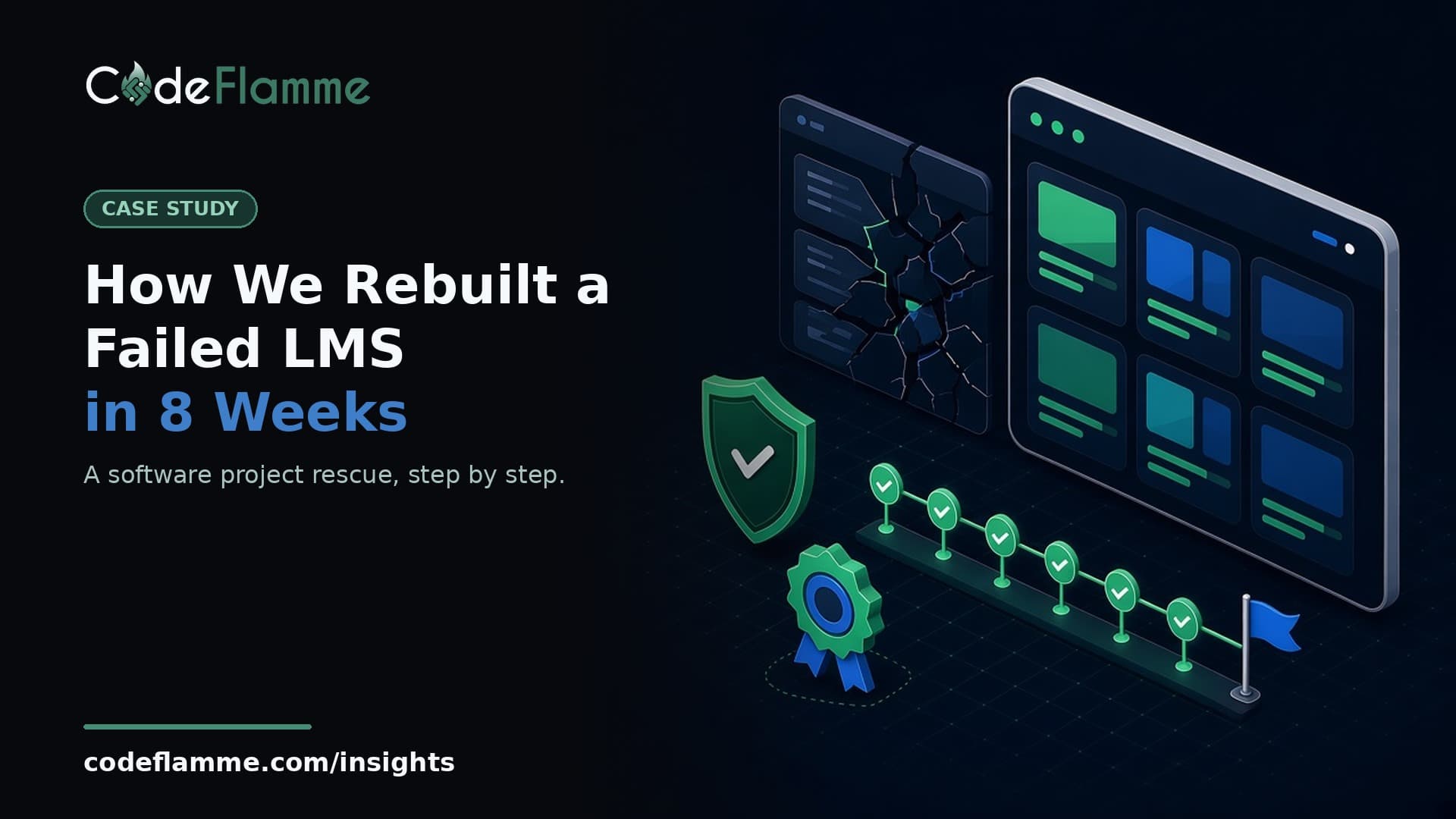
Most software project rescue stories start the same way. A founder has paid for months of work, has seen demos, and still has nothing customers can log into. That was the situation when Brandsonify came to us about Cyber Guardians, a cybersecurity training platform now live at cyberguardiansllc.com. Brandsonify had lost four months with a previous team without getting a production-ready learning platform. We rebuilt it from scratch in eight weeks. This post walks through how we approached that rescue, what we decided early, and what any founder in the same spot can take from it. The facts about the project come from our published full Cyber Guardians case study ; the rest is the playbook we would give you if you called us tomorrow.
What had to exist, not what had been demoed
Cyber Guardians is not a brochure site. It sells real cybersecurity training to businesses, so the platform needed course catalogs, interactive lessons, quizzes, labs and certificates, across modules that include general cybersecurity, banking regulation, CMMC, CCPA and GDPR. It also needed enrollment and purchase flows that match how Cyber Guardians actually sells training. The bar Brandsonify set was operational reliability, not slideware. Stakeholders needed an LMS they could sell and run. That framing matters in any rescue: the question is never "how much of the old work can we show?" It is "what must be true on launch day for the business to operate?"
Decision one: rebuild, not patch
We treated Cyber Guardians as a greenfield rescue. After four months without a production-ready platform, the fastest credible path was a clean rebuild on a stack the team could maintain, rather than stabilizing code nobody on the new team had written. That is not always the right call. Our software rescue playbook covers when stabilizing beats rebuilding, and rewrite vs incremental rescue walks through the same trade-off for Next.js products. The short version: rebuild when the existing system cannot reach production without rewriting its core anyway, and when the scope is clear enough to estimate in weeks, not quarters.
Decision two: validate the learning model first
Before writing much code, we validated the learning model: how courses, lessons, quizzes, labs and certificates relate, and how the content structure maps to the way Cyber Guardians packages and sells training. In an LMS, that model drives almost everything downstream, from the catalog to purchase flows to certificates. For founders, the lesson generalizes. Every rescue has one or two core domain models that the previous team either got wrong or never wrote down. Naming them early, in plain language the business agrees with, removes a large share of the rework that sinks a second attempt.
Decision three: a stack chosen for maintenance
We rebuilt the platform as a modern JavaScript web app: React and Next.js on the front end, Node.js on the back end, and AWS for cloud infrastructure. The choice favored a maintainable web app with room to grow over anything novel. In a rescue, boring is a feature. The founder has already paid once for an experiment. The second build should use tools that many engineers know, that hire easily, and that the founder can hand to another team later if needed. That is also why we push for clean ownership terms, covered in our app development contract checklist .
Decision four: weekly milestones with QA gates
Eight weeks is short, so we ran the project in weekly milestones, each with a QA gate before it counted as done. Brandsonify leadership could see real progress every week instead of waiting for a big reveal. Weekly gates do two things in a rescue. They rebuild trust, because the founder sees working software on a predictable rhythm after months of slipping dates. And they surface scope problems early, while there is still time to cut or re-sequence instead of discovering them in the final week.
Decision five: senior people, direct line
The same senior engineers scoped and shipped the work, and communication stayed direct with Brandsonify leadership, with no bench rotation. In a compressed timeline there is no room for a sales team to promise one thing and a rotating junior bench to deliver another. If you are evaluating a team for a rescue, ask who exactly will write the code and whether those people are on the scoping call. Our guide on hiring a senior dev team without getting bench-rotated lists the questions we would ask in your shoes.
What shipped
Within eight weeks the rebuilt LMS was launch-ready, and Cyber Guardians is live at cyberguardiansllc.com with its regulatory course catalog, covering banking, CMMC, CCPA, GDPR and more. Brandsonify's founder, Rousseau Aurelien, summed it up in the testimonial on our case study: "just 8 weeks to rebuild from scratch… a flawlessly executed, scalable LMS that exceeded our expectations." We are deliberately not quoting traffic, revenue or user numbers here. We only publish figures our clients have approved, and the point of this post is the decision sequence, not a vanity metric.
A founder checklist for your own rescue
1. Write the launch-day list. What must customers be able to do, pay for and receive on day one? 2. Decide rebuild vs stabilize on evidence. Can the current code reach production without rewriting its core? 3. Name the core domain model. For an LMS it was courses, lessons, assessments and certificates. Yours might be orders, patients or jobs. 4. Pick a stack you can hand over. Favor widely known tools and clear IP and source-code terms. 5. Insist on weekly, tested milestones. Progress you can click beats progress reports. 6. Meet the people who will build it. Senior engineers on the scoping call, and a direct line to them after.
If you are months into a project that still is not live and you want an honest read on whether to rebuild or stabilize, talk to our team or browse our services to see how we take over stalled builds.