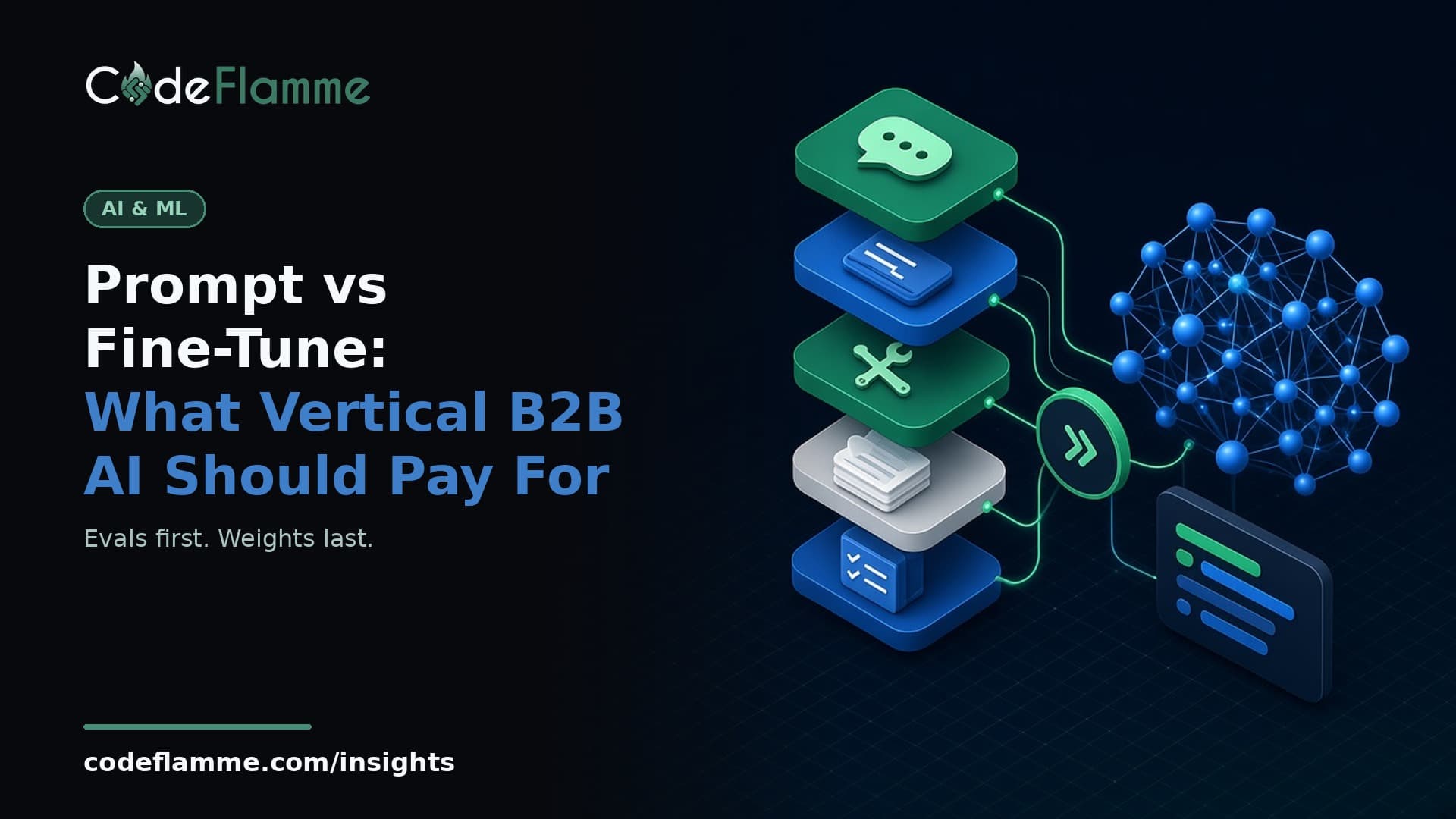
Vertical AI pitches often jump to fine-tuning because it sounds like moat. In practice, many B2B workflow wins come from sharp prompts, structured outputs, retrieval over customer artifacts, and tools that hit systems of record — measured by an eval harness. Fine-tuning is real and useful, but it is a specialization tax: data ops, refresh cadence, and regression risk. This brief helps founders choose prompt-centric versus fine-tuned approaches for vertical workflows without vanity ML spend (reviewed November 2026).
Start with the failure mode
If the model fails because it lacks private facts, prioritize retrieval and permissions. If it fails because it will not follow a schema, prioritize structured outputs and validators. If it fails because tone/domain phrasing is consistently wrong despite good prompts and examples, then fine-tuning enters the conversation. Misdiagnosing “needs weights” when you needed tools wastes quarters.
When prompts (and scaffolding) are enough
Enough for many vertical slices: classification with labeled rubrics, extraction into schemas, drafting with human approval, and routing to tools. Invest in prompt versioning, golden sets, and regression CI. These practices transfer if you later fine-tune — they are not throwaway work.
When fine-tuning earns its keep
Consider fine-tuning when you have stable task distribution, clean labeled examples at meaningful volume, and a latency/cost constraint that smaller specialized models satisfy better than large general models with long prompts. Also consider it when you must lock behavior for a regulated-style workflow and prompts alone drift too much across model vendor updates — still keeping humans and validators in the loop. Budget ongoing refresh: product changes stale a fine-tune. Ownership includes data pipelines, not a one-off job.
Data and privacy gates
Fine-tuning on customer data raises contractual and privacy questions. Prefer synthetic or permissioned corpora. Document retention and whether tenant data can train shared models — most B2B buyers expect a clear no unless separately agreed. Prompting with RAG over tenant stores is often the compliant path to “personalized.”
Decision checklist
Ask: Do we have an eval set? Which error class dominates? Is the data legally usable? Can tools+schema fix it cheaper? Who owns refresh? What is the rollback if the tuned model regresses? Honest answers keep you out of ML theater.
RAG and tools as customization
Much “verticalness” lives in your data and systems of record, not in weight updates. Permissioned retrieval, tool calling into the workflow API, and schema-constrained outputs customize behavior without a fine-tune. Founders should taxonomize customization: content, tools, policy, weights — and pick the cheapest layer that fixes the error class.
Eval harness as the decision engine
Maintain golden tasks from real anonymized workflows. Score prompt-only, prompt+RAG, and fine-tuned variants with the same rubric. Include cost and latency. If a fine-tune wins on quality but loses on refresh cost and regression rate, it may still be the wrong business choice. Publish results internally so roadmap debates use evidence.
Vendor lock and portability
Fine-tunes can deepen vendor coupling. Prefer techniques and data formats you can rebuild elsewhere. Keep prompt bundles and evals portable even if weights are not. Negotiate training-data usage explicitly in vendor contracts.
Team shape
Prompt+evals+tools fits product engineers with applied AI practice. Sustained fine-tuning needs ML ops discipline. Hire or contract for the path you choose; do not assign a lone app engineer a fine-tune program without data ownership. Agencies should state which path they are staffed to maintain after launch.
Sequencing a vertical launch
Ship: workflow UI → schemas → tools → RAG → evals → only then consider fine-tune. Each step should improve a measured metric. Skipping to fine-tune to impress a board deck is a common failure mode; avoid it.
Synthetic data and labeling cost
Fine-tunes need labels. Budget SME time honestly. Synthetic data can bootstrap but often misses edge cases that matter in vertical workflows. A smaller, cleaner set beats a large noisy one. If you cannot staff labeling, you cannot staff fine-tuning — stop at prompts and tools.
Regression across model vendor updates
Base model updates can invalidate both prompts and fine-tunes. Keep a regression cadence when vendors move. Fine-tunes may need rebuilds; prompts may need edits. The eval harness is the constant. Without it, every vendor update is a dice roll against customer workflows.
Customer-specific adapters
Enterprises may ask for “our own model.” Often they need their own prompts, retrieval corpora, and policy packs — not a unique fine-tune per tenant. Prefer configuration surfaces that scale. Offer fine-tunes only when the economics and data rights are explicit.
Cost storytelling for the board
Executives hear “fine-tune” as progress. Translate into unit economics: labeling hours, eval cadence, inference cost, and refresh risk versus a prompt+tools baseline that already hits the quality bar. Fund the path that moves workflow completion and gross margin — not the path that sounds most like AI. Bring the eval comparison chart to the decision meeting and keep the losing variants in the archive for later re-checks.
Founder takeaway
For vertical B2B workflows, prompts, schemas, tools, RAG, and evals are the default stack. Fine-tune when measurement proves a specialization need you can maintain. Moat comes from workflow ownership and reliability, not from having a fine-tune checkbox on the marketing site. If you are still deciding what to build, three related guides help. Vertical AI beats horizontal chat explains how to pick the one expensive workflow worth automating. Production RAG vs "we wrapped GPT" covers what a real retrieval layer looks like before anyone talks about weights. And your LLM bill is a product problem shows how to put cost next to quality when you compare variants. If you want a second opinion on whether your vertical workflow needs a fine-tune or just a better eval harness, talk to our team .