Every AI feature in a B2B product eventually receives data nobody planned for: a support ticket with a customer's phone number, a CRM note with a home address, an uploaded contract with bank details. If that text goes straight into a third-party model call, your data processing story now depends on a vendor's retention settings and your own log pipeline. Enterprise security reviews increasingly ask a sharper question than “do you use AI?” — they ask what personal data leaves your boundary and how you know. This brief is for founders who want a redaction layer that is real infrastructure: a pipeline between your application and every model call, not a regex someone added to one endpoint.
Decide what must never leave
Start with a data classification, not a library. List the entity types that matter for your customers: names, emails, phone numbers, government identifiers, payment details, health information, free-text addresses, and any domain-specific identifiers such as account or policy numbers. For each, decide the rule per workflow: remove entirely, replace with a reversible token, generalize (a city instead of a street address), or allow because the feature genuinely needs it and the contract covers it. Write the matrix down; security reviewers will ask for it and your engineers will need it.
Detection: layered, not magical
Combine deterministic patterns with statistical detection. Pattern recognizers handle well-formed identifiers such as emails, card numbers with checksum validation, and known ID formats. Named-entity recognition catches names and locations in free text. Open-source toolkits such as Presidio package both approaches with an analyzer and an anonymizer you can extend with custom recognizers. Add your own recognizers for tenant-specific identifiers; generic models do not know what your customers' internal reference numbers look like. No detector is perfect. Measure recall on a labeled sample of your real traffic shape and accept that you are reducing exposure, not guaranteeing zero leakage. Say that honestly in your Trust Center.
Reversible pseudonymization keeps features useful
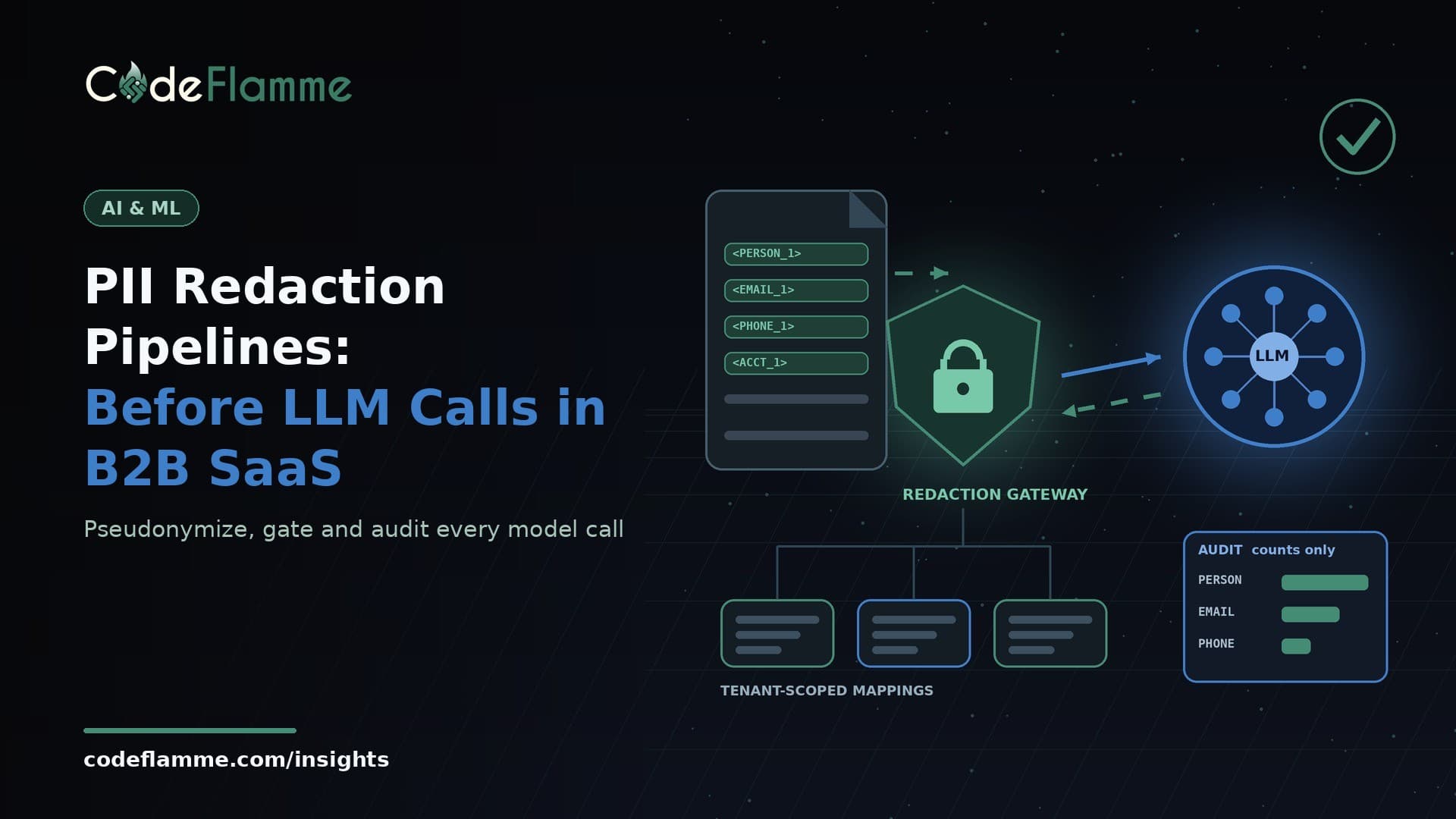
Blanket masking often breaks the feature. A summarizer that sees “[REDACTED] told [REDACTED] about [REDACTED]” produces useless output. Reversible pseudonymization replaces each distinct value with a stable placeholder — <PERSON_1> , <EMAIL_2> — so the model can reason about who did what, then your service restores the original values in the response before showing it to an authorized user. The mapping table is the sensitive asset: keep it in memory or a short-lived, tenant-scoped store, never in prompt logs, and expire it with the request or session.
// Illustrative pipeline around every model call
async function safeComplete(tenantId: string, input: string) {
  const policy = await policies.forWorkflow(tenantId, 'ticket_summary');
  const { text, mapping } = await pseudonymize(input, policy); // <PERSON_1>, <EMAIL_1>
  const raw = await llm.complete({ prompt: text });
  const restored = restore(raw, mapping); // only for authorized viewers
  mapping.destroy(); // never persisted to logs
  return restored;
}
Put the pipeline in one place
Redaction fails when it is optional. Route all model traffic through a single internal gateway or SDK that applies the policy, records which entity types were found (counts, not values), and refuses calls that skip the pipeline. That same choke point is where you enforce model allowlists, tenant residency rules, and spend caps. If product teams can import a vendor SDK directly and call a model, assume someone eventually will — block it in code review and with egress rules.
Logs, traces, and evals are part of the boundary
Teams often redact the prompt and then log the raw input in an observability tool for debugging. Apply the same policy to traces, prompt logs, and eval datasets. When you build evaluation sets from production traffic, store pseudonymized versions and get explicit approval for any exception. Retention matters too: decide how long prompt logs live, who can read them, and how a customer deletion request propagates into them.
Tool calls and retrieval leak too
Agentic features add new paths. A model that can call a search tool or read a CRM record may pull personal data back into its context after your input redaction ran. Apply output-side checks on tool results, keep retrieval scoped to the requesting user's permissions, and redact before re-sending tool outputs to the model where the workflow allows. Treat the context window as a data flow, not a single prompt.
Measure the cost to quality
Redaction changes model behavior. Run your eval harness with and without the pipeline and look at task success, not just whether placeholders appear. Some workflows will lose too much quality under aggressive rules; those are product decisions to escalate, not engineering defaults to bury. Sometimes the right answer is a private or regional deployment for a tenant segment rather than weaker redaction for everyone.
Give tenants control and visibility
Enterprise customers increasingly want to configure the policy themselves: turning AI features off for certain workspaces, adding their own identifier patterns, or requiring stricter rules for specific data types. Expose those as admin settings with sensible defaults, and show admins an activity view of which AI features processed their data and which entity types were redacted, as counts rather than values. That transparency shortens security reviews and reduces the fear that drives customers to ban AI features outright. It also gives your success team something concrete to show when a customer asks how their data is handled.
Related reading
Redaction is one layer of a wider AI data boundary. For the tenant side of the same problem, read the multi-tenant AI isolation mistakes that become breaches . If enterprise buyers are already sending security questionnaires, the AI governance checklist buyers ask for in 2026 covers what they expect to see, and private and open-weight models for regulated buyers explains when redaction is not enough and a tenant needs its own inference. To see what your pipeline is actually doing in production, pair it with agent observability that logs counts, not values. Want a second pair of eyes on how customer data reaches your model calls? Talk to our team .
Founder takeaway
A PII redaction pipeline is how AI features earn their way through enterprise procurement. Define a per-workflow policy, layer detection, use reversible pseudonymization where quality demands it, centralize every model call behind one gateway, and apply the same rules to logs, tools, and eval data. Then publish what you do — and what you do not guarantee — so buyers can trust the answer.