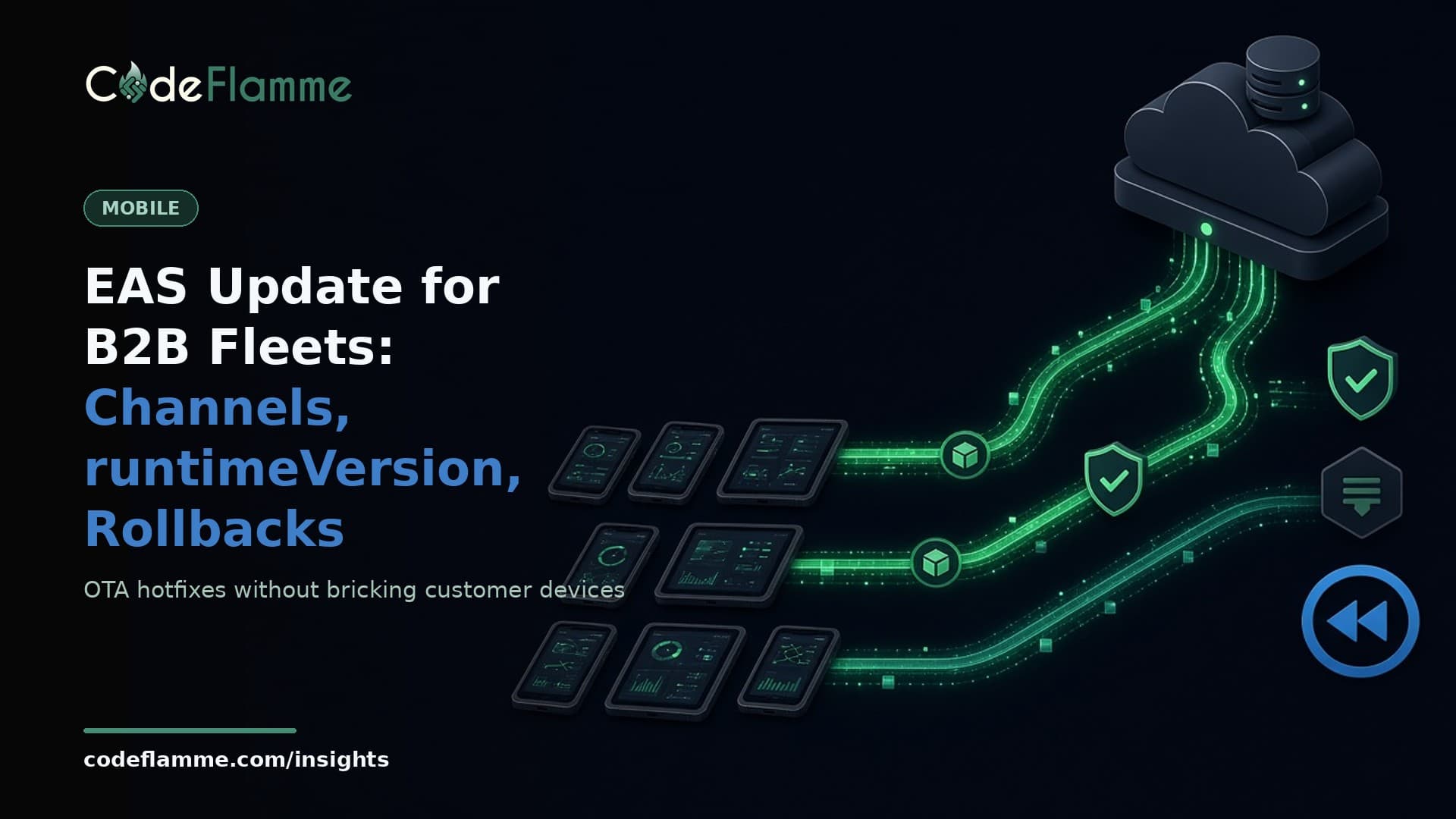
Field apps live or die on hotfix speed. Expo’s EAS Update lets you push JavaScript and assets without a store review — and that power is exactly how teams brick a customer fleet when channels and runtimeVersion are fuzzy. This brief is for founders shipping B2B React Native / Expo companions who need OTA without weekend war rooms. The mental model is simple: channels choose the environment (staging vs production), runtimeVersion chooses which native binaries may apply the bundle. Miss either dimension and you get “works on our phones, crash on theirs.”
Channels before heroics
Configure distinct channels for preview/staging and production. Publish candidates to staging first, soak with internal or pilot tenants, then promote the same artifact to production (republish / promote patterns beat rebuilding from a dirty laptop). Never point a production binary at a channel that also receives experimental feature branches. Document who can publish to production OTA. Treat update publishing like production deploys: signed access, CI service accounts, and an on-call checklist. OTA without change control is just shadow shipping.
runtimeVersion that protects fleets
Pick a runtimeVersion policy on purpose. Expo's docs describe the trade-off plainly: the appVersion policy bumps the runtime whenever you bump the app version, but if someone changes native code and forgets that bump, old binaries will accept an update they cannot run. The fingerprint policy changes the runtime whenever anything that may affect native code changes, which makes incompatible updates very unlikely at the cost of more frequent builds. For B2B fleets we lean toward fingerprint, or appVersion with a CI check that fails when native paths change without a version bump. When you add native modules, permissions, or move an Expo SDK major line, ship a new binary. Do not push a JS update that assumes native APIs the old binary lacks. Expo notes that expo-updates may detect the error and roll back, but "may" is not a plan an enterprise customer will accept. MDM customers often pin binaries for months; your OTA strategy must respect that lag. Code signing for updates matters in enterprise conversations. Buyers ask how an update is verified before apply. Have a one-pager: certificate embedded in the binary, signing in CI, rotation runbook. Skip hand-wavy answers in security reviews.
{
  "expo": {
    "runtimeVersion": { "policy": "appVersion" },
    "updates": { "url": "https://u.expo.dev/<project-id>" }
  },
  "eas": {
    "build": {
      "preview": { "channel": "staging" },
      "production": { "channel": "production" }
    }
  }
}
Operational rules that prevent bricking
Do not run a binary store rollout and a production OTA at the same time — crash signals become uninterpretable. Watch crash and update metrics for a defined soak window after every production publish. Keep a documented rollback. EAS Update supports two kinds through eas update:rollback : re-publishing a previously published update, or telling clients to fall back to the update embedded in the build. Know which one you would use for each runtime before you need it. Separate “JS-only hotfix” from “needs native.” If the fix touches camera permissions, background modes, or new native modules, force a binary. OTA is not a bypass for App Store / Play process when native contracts change.
What founders should ask eng weekly
Which runtimes are still receiving production updates? Which customer fleets are stuck on old binaries? What is the oldest supported runtime, and when do we cut it? OTA without an end-of-life policy becomes infinite support for abandoned native shells.
Pilot tenants and staged OTA
Maintain a pilot channel or branch that production binaries can optionally opt into via a managed config flag or internal build flavor. Soak fixes with friendly customers before production channel publish. Measure crash-free sessions and a critical job-success metric during soak — not only “update downloaded.” When a bad update ships, speed matters more than pride. Republish the previous bundle, notify CSM for fleets on the bad runtime, and write a short incident note even if external customers never filed tickets. Quiet OTA incidents still deserve blameless postmortems.
Native module discipline
Create an eng checklist: does this PR touch ios/ or android/ native projects, config plugins, permissions, or Expo SDK major? If yes, it is a binary release. Automate detection in CI by diffing native paths. Founders should reject “we’ll OTA the JS and hope the native module is already there” as a release strategy.
Enterprise communications
Give IT admins a one-pager: how updates are signed, how to pin or delay updates in MDM, and how to report a bad rollout. Some enterprises require change tickets before OTA — build a human process, not only a CLI. Align store release notes with OTA changelog entries so support is not guessing which binary a site is on.
Metrics that prove control
Track: % of production sessions on the latest runtime, age of oldest active runtime, OTA success vs rollback count, and time-to-rollback. If oldest runtimes never die, you are paying forever for compatibility. Set an EOL policy and communicate it in release notes six months ahead when possible.
Implementation notes for the first ninety days
Pick an owner, write the policy in a one-pager, and schedule a rehearsal in staging. Instrument the happy path and the failure path before you market the capability. Review outcomes with product, eng, and go-to-market after the first real customer hits the edge case — then harden defaults. Resist boiling the ocean: ship the narrowest version that removes the existential risk, then iterate on polish. Keep a living checklist in your engineering wiki linked from the runbook. New hires should be able to explain the policy without pinging the original author. If they cannot, the system is still tribal knowledge dressed as process.
Related reading
If you are planning the binary side of this, start with our Expo SDK 58 upgrade plan for production React Native apps and the React Native 0.89 native module audit . For navigation architecture in the same apps, see Expo Router vs React Navigation for B2B product teams , and for the budget picture after launch, what founders should budget for app maintenance in year one . Want a second pair of eyes on your OTA policy? Talk to our team .
Founder takeaway
EAS Update is a product capability, not a shortcut around release engineering. Channels segregate environments; runtimeVersion protects incompatible natives; signing and access control satisfy enterprise buyers. Write the policy once, automate publishes, and stop treating OTA as a console button anyone can press after standup.