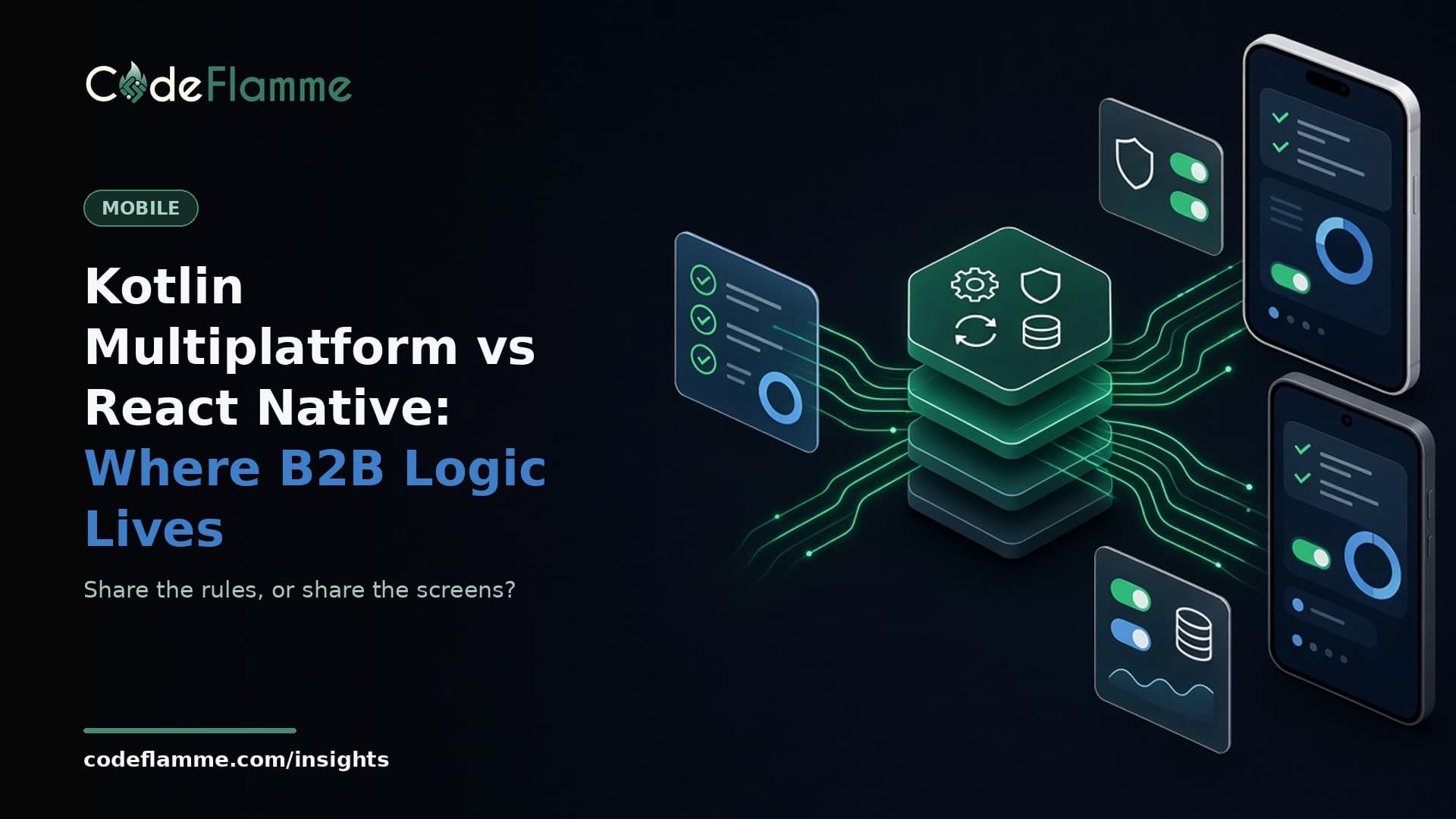
Cross-platform debates waste quarters when founders treat them as religion. For B2B products — field ops, companion apps beside a web SaaS, offline workflows tied to ERP-ish backends — the real question is narrower: what must be identical on iOS and Android, and who will maintain it for two years? Kotlin Multiplatform (KMP) and React Native answer that differently. RN typically shares UI and logic in one product codebase. KMP commonly shares the engine — validation, sync rules, networking, domain models — while keeping SwiftUI / Jetpack Compose (or Compose Multiplatform later) for the cockpit. This is a 2026 founder brief for choosing with hiring and risk in mind, not Twitter threads. If you are still deciding between shared-UI frameworks, start with our React Native vs Flutter guide ; if you are unsure you need a native app at all, read native app vs responsive web first.
What you are actually choosing
React Native optimizes for one product team shipping screens and behavior together, often with web-adjacent TypeScript skills. KMP optimizes for identical business rules across platforms when UI fidelity or platform APIs matter more than a single UI framework. Both can ship excellent B2B apps. They fail when chosen for the wrong team shape. If your hardest problem is keeping promotional UI consistent across brands, RN or Flutter-style shared UI may dominate. If your hardest problem is identical offline conflict resolution, entitlement checks, or calculation engines that must never diverge, shared logic architectures earn their keep.
Where things stand in November 2026
Both options are production choices now, not experiments. Google's Android developer documentation describes Kotlin Multiplatform as officially supported by Google for sharing business logic between Android and iOS, and calls it stable and production-ready. Several Jetpack libraries B2B apps lean on, including Room, DataStore, ViewModel, Lifecycle and Paging, now ship KMP support, so a shared data and persistence layer no longer means hand-rolling everything. On the UI side, JetBrains' Compose Multiplatform is at 1.12.2 (released October 15, 2026), with iOS 14 as the minimum supported iOS version and 1.13 in beta. React Native keeps its own steady release train; our React Native 0.89 upgrade plan covers the current iOS dependency changes. The question is no longer "is it ready?" but "which layer does my team need to share?"
When React Native is the pragmatic B2B default
Strong fit: CRUD-heavy workflows, CRM/field companions, approval queues, document capture, and apps where hiring full-stack TS/RN talent is easier than dual native squads. Speed to first vertical slice matters. Agencies and product studios already standardized on Expo/RN can deliver predictable cadence, provided they keep up with releases like Expo SDK 58 . Also strong when your web app and mobile share product language and you want one design-system mentality. Just be honest about native modules: push, background sync, secure storage, and MDM quirks still need platform expertise. “One codebase” never meant “zero native work.”
When KMP shared logic wins
Evaluate KMP when business rules are large, regulated, or must match Android and iOS bit-for-bit: pricing engines, clinical-ish workflows with strict validation (product engineering, not medical advice), offline sync FSMs, or security policies that auditors will ask to see once. Teams with strong Kotlin/Android depth can extend that investment into a shared module without rewriting UI twice in JS. KMP is weaker as a fashion migration mid-roadmap if you already have a healthy RN app and no divergence crisis. Shared-logic benefits arrive when the logic layer is the product risk — not when you merely dislike maintaining two UI toolkits.
Hiring, agencies, and coexistence
Write the job post for the next eighteen months. (Deciding how to staff it at all? See agency vs freelance vs in-house .) RN shops hire differently than Kotlin-native shops. If you will staff through agencies, specify Expo vs bare, whether KMP modules exist, and who owns release trains. Mixed stacks need a written boundary: which features live in shared Kotlin modules versus RN screens, and how CI proves parity. Coexistence is real: some orgs keep RN UI while extracting a critical domain module — or keep native UI with KMP underneath. Ambiguous ownership is how sync bugs become “iOS only” folklore.
Offline, security, and enterprise wrappers
B2B buyers care about MDM, SSO, certificate pinning stories, and predictable offline behavior. Architecture should make those policies testable. Shared logic helps when the policy is code. It does not replace device management or store review realities. Budget native specialists either way for the last mile.
Decision checklist
Ask: Where do bugs hurt most today — UI inconsistency or rule divergence? Which skills can we hire in our market? Do we need Compose/SwiftUI fidelity for platform trust? Is offline sync a core workflow or a nice-to-have? Can we ship a vertical slice in ninety days with the chosen stack? Score those honestly; ignore conference demos.
What to put in the shared module first
If you trial KMP, start with a bounded domain: entitlement checks, offline conflict resolution, or a validation engine — not “rewrite the app.” Define Kotlin APIs that native or RN bridges call. Add property tests so iOS and Android cannot drift. Expand only when the module proves it removes real duplicate bugs. For RN-first teams, the analog is extracting a TypeScript domain package shared by app and (sometimes) web. Same discipline: pure functions, tested once, thin UI adapters.
Tooling, CI, and release trains
Shared logic fails when CI does not build all consumers on every change. Require pipelines that compile the KMP framework for iOS/Android (or the RN domain package for both app binaries) before merge. Version the shared artifact; avoid “just copy the folder.” Release notes should call out shared-module changes that affect both stores. Binary size and debug symbol strategy matter for field apps on constrained devices — budget profiling time when sharing grows.
UI strategy without dogma
KMP-with-native-UI, KMP-with-Compose-Multiplatform, and RN-with-native-modules are different products bets. Compose Multiplatform can reduce UI duplication for Kotlin-centric teams, but it changes hiring and library availability. Do not assume “we picked KMP” answers the UI question automatically — decide explicitly and write it down. For RN, be equally explicit about when you drop to native views for cameras, maps, or secure enclave flows.
A ninety-day proof
Whatever you choose, demand a vertical slice: one authentic workflow, both platforms, offline or SSO if those are core, crash-free dogfood with a design partner, and a staffing plan. Architecture slides without a shipped slice are theater. Kill or double-down based on that proof, not conference energy. For budget framing, our MVP cost ranges show how scope drives the number more than the framework does.
Founder takeaway
Kotlin Multiplatform versus React Native is a bet on which layer must stay identical. For many B2B apps, RN remains the faster product default. When shared business rules are the risk surface — and you have Kotlin depth — KMP’s shared-logic model is the sharper tool. Choose with staffing and divergence risk, not slogans. If you want a second opinion on your stack, talk to our team or browse our mobile and product services .