
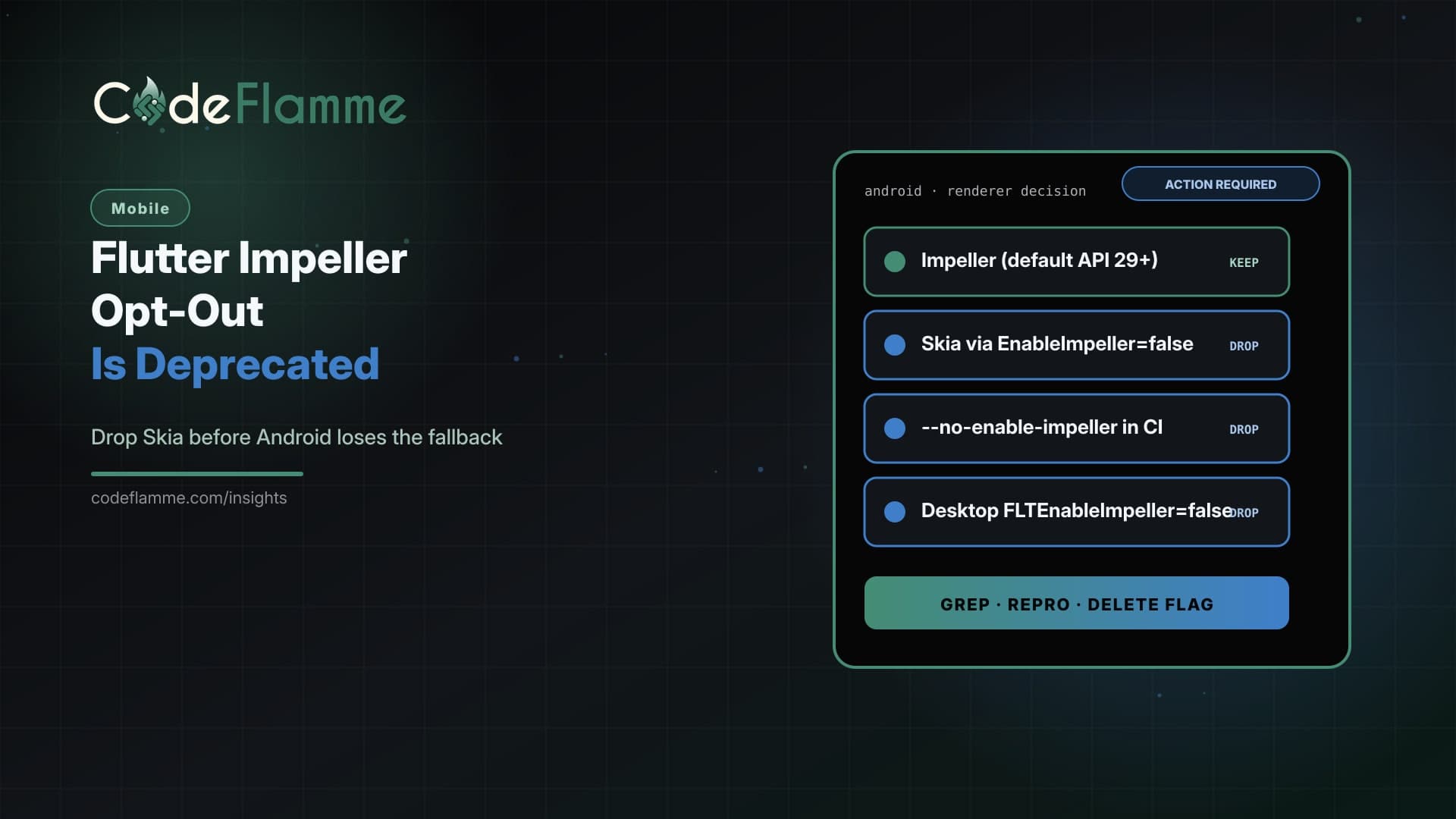
If your Flutter app still ships with EnableImpeller set to false, or your CI still passes --no-enable-impeller , you are on a path Flutter has already marked for removal. As of today, Impeller is the default renderer on Android API 29 and above, the engine prints an Action Required warning when you opt out, and Flutter's 2026 roadmap says the team is completing the Impeller migration on Android and removing the legacy Skia backend on Android 10 and above. The opt-out still works on current stable builds, but it is deprecated. Founders who treat that warning as noise will discover the hard way that a graphics escape hatch is not a product strategy.
What changed, and what did not
Impeller became the default on modern Android devices in Flutter 3.27. Official Impeller docs still document two ways to disable it: the --no-enable-impeller CLI flag for debug runs, and the io.flutter.embedding.android.EnableImpeller meta-data entry set to false in AndroidManifest.xml for releases. That escape hatch is why some B2B teams kept Skia after an early Impeller fidelity bug on a specific chipset or after a custom shader broke. What changed is the tone of the engine. When you opt out, Flutter logs that the options are going away in an upcoming release and that you should remove the opt-out or file a bug if you still need it. On desktop, Impeller became the default in Flutter 3.47, and the same docs say fallback options will be removed in a future release. The message is consistent: Skia is not the long-term plan.
Why B2B Flutter apps hide behind the opt-out
The common reasons are boring and real. A field tablet fleet runs mid-range MediaTek or PowerVR silicon where Vulkan was denylisted and Impeller OpenGL ES looked wrong on one screen. A custom FragmentShader or a third-party chart package assumed Skia behaviour. A platform view for maps or a WebView looked better under the old composition path. None of those reasons age well once Flutter removes the switch. They become release blockers on the next stable bump your security or store policy forces you to take. Flutter 3.44 also tightened Android platform views with Hybrid Composition++ and kept improving Impeller Vulkan. That is the direction of travel. If your team's written plan is still "stay on Skia until Impeller is perfect," rewrite the plan. Perfection is not coming as a second renderer you can keep forever.
Desktop is on the same clock
Do not treat this as an Android-only chore. Flutter 3.47 made Impeller the default on macOS, Windows, and Linux. The Impeller docs for each desktop embedder still show how to disable it, and they say the same thing Android's warning does: fallback options will be removed in a future release. If you ship a companion desktop build for ops teams, or you test Flutter on Linux CI images, grep those embedders too. An Android-only cleanup that leaves FLTEnableImpeller false on macOS just moves the surprise to the next desktop release train. Also separate engine choice from package choice. React Native teams have their own Skia story with React Native Skia 3 and Graphite ; that is a different library with different minsdk rules. Flutter's Impeller decision is about the engine you already ship. Mixing the two in one planning doc confuses owners and delays the work that actually unblocks your next Flutter upgrade.
A founder checklist you can run this sprint
# Find Impeller opt-outs in the Android tree
rg -n "EnableImpeller|--no-enable-impeller|FLTEnableImpeller|set_enable_impeller|ImpellerSwitch::Disabled" \
  android/ ios/ macos/ windows/ linux/ --glob '!**/build/**'

# Confirm what a device actually runs (debug)
flutter run -d <device> -v 2>&1 | rg -i "impeller|skia|Action Required"
Inventory. Grep every app, white-label flavour, and CI script for the opt-out. Many agencies leave the flag in a flavour that only ships to one enterprise customer. Reproduce on Impeller. Remove the flag on a branch, build a release-like APK, and walk the screens that historically failed: login, charts, PDF preview, maps, camera, offline sync. Capture device model, Android version, and GPU in the bug report if something still breaks. File or fix. If Impeller is wrong, open a Flutter issue with a minimal sample while opt-out still exists. If the bug is in a plugin, open it on the plugin and pin a workaround that does not require Skia forever. Retire the flag. Once the branch is clean, delete the manifest entry and the CI argument in the same PR so they cannot creep back.
How this fits the rest of your 2026 mobile calendar
Impeller is one line on a crowded board. Apple's April 2027 App Store floor needs the iOS 27 SDK and UIScene adoption, which we covered in Apple's April 2027 deadline . Flutter 3.44 made Swift Package Manager the default for iOS and macOS and froze Material and Cupertino ahead of the package split we wrote about in the Material and Cupertino migration guide . If you are still choosing stacks, React Native versus Flutter in 2026 is the decision frame. Put Impeller next to those items so graphics debt does not land in the same month as a store policy change.
Founder takeaway
Flutter has told you the ending: Impeller is the renderer, Skia opt-outs are deprecated, and the 2026 roadmap removes the legacy Android Skia path on Android 10 and above. Your job is to find every opt-out, prove the app on Impeller, and delete the escape hatch while you still control the timeline. Teams that wait for the flag to disappear will spend that release fixing shaders under store pressure instead of shipping product. Want a second pair of eyes on a Flutter release pipeline before the next stable forces your hand? Talk to the CodeFlamme team .