
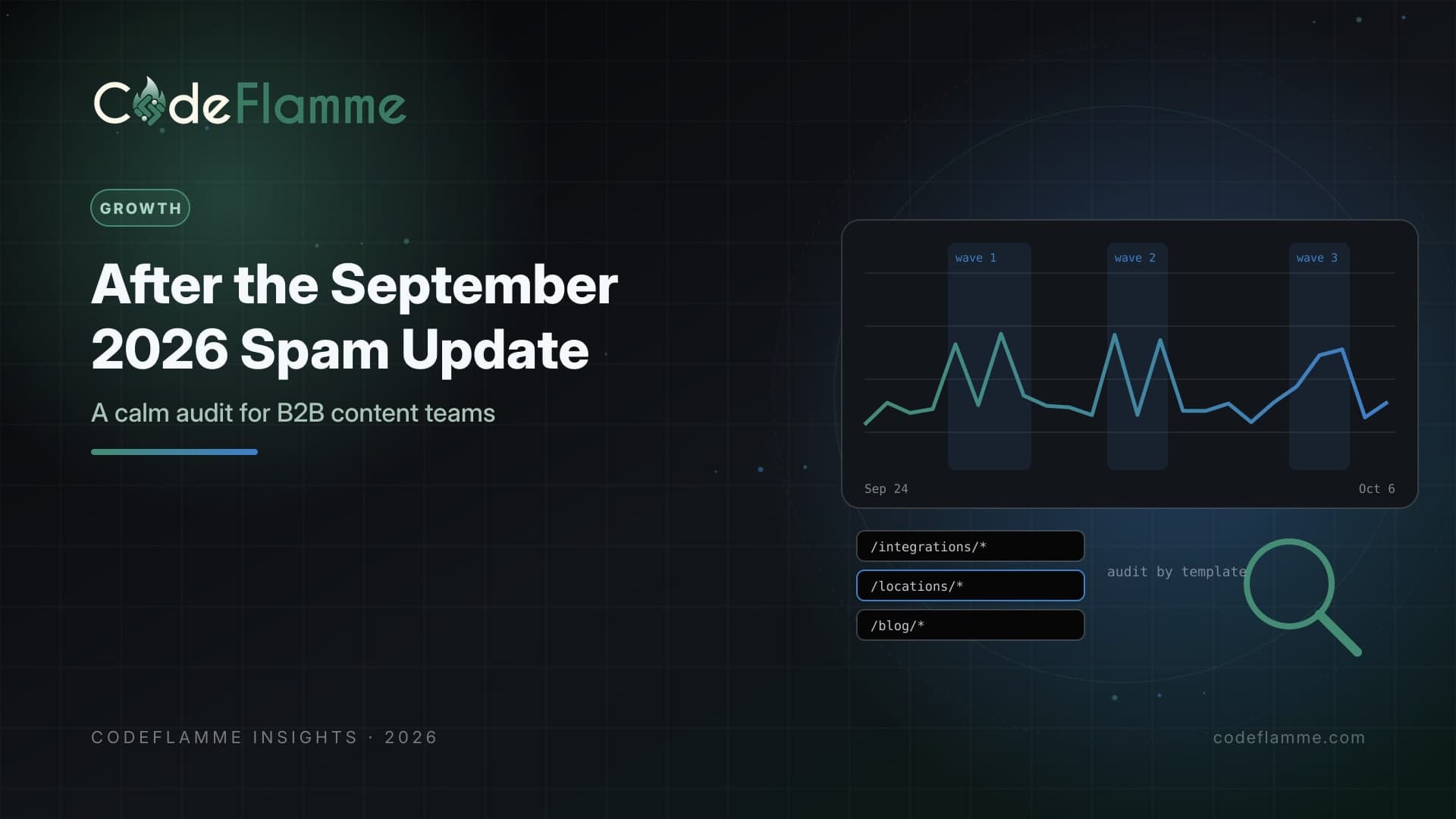
On September 24, 2026, Google released its September 2026 spam update, saying it applies globally and to all languages and that the rollout could take up to two weeks. It is the fourth spam update of the year, after cycles in March, June, and August, and the first this year with a two-week rollout window rather than a few days. Google did not name specific targets, and it described the release as a normal spam update. Industry trackers reported several waves of ranking volatility during the rollout, the latest around October 4 to 6. If your traffic moved in the last two weeks, it is tempting to start rewriting pages immediately. Don't. First work out whether the update is a plausible cause, then fix the specific problems Google's spam policies describe.
Read the data before you react
Check Google's Search Status Dashboard for the official rollout dates, then compare them with your Search Console performance data. Look at pages and queries, not just total clicks. A spam update that affects your site usually shows up as sharp drops on particular sections or page types, aligned with rollout dates. A gradual decline across everything is more likely to be seasonality, a competitor, a technical issue, or the continuing shift of clicks into AI answers. Google itself cautions that ranking changes during an update window may be unrelated fluctuation.
Where B2B sites take spam-policy risk
Most B2B SaaS and agency sites are not spam sites, but growth tactics from recent years can drift into territory Google's spam policies cover. The patterns to check first are scaled content abuse, such as hundreds of near-identical pages generated for every city, industry, or integration combination with little unique value; site reputation abuse, where third-party content is hosted on your domain mainly to benefit from its authority; and expired or repurposed domains pointed at your site. Also check for doorway-style landing pages built only to rank, and for hacked or user-generated spam in forgotten corners such as old community forums, documentation comments, or staging subdomains.
Post-update audit (B2B site)
1. Search Console: compare 14 days pre vs post 2026-09-24 by page
2. Group losers by template: /integrations/*, /locations/*, /blog/*
3. For each group: unique value? search intent met? thin or templated?
4. Check for third-party or sponsored content on your domain
5. Scan for hacked pages, spam UGC, forgotten subdomains
6. Fix or noindex; keep a dated change log
Programmatic pages need real value
Programmatic SEO is not banned. Integration pages, template galleries, and comparison pages can be genuinely useful. The question is whether each page offers something a searcher cannot get from the page next to it. An integration page with real setup steps, screenshots, limitations, and use cases is helpful. Two hundred pages that swap a logo and a product name into the same paragraph are what scaled content abuse policies describe. If a group of pages lost visibility, consolidate the weakest ones, enrich the ones that matter to buyers, and noindex the rest rather than deleting your way into broken links.
Avoid panic edits
Rewriting everything at once makes it impossible to learn what worked. Google says that sites violating spam policies may see improvement after making changes, as its automated systems learn over a period of months that the site complies. That means recovery is slow even when the fix is right. Change one page group at a time, log what you changed and when, and judge results over weeks, not days. If you were not affected, use the moment to remove risky pages before a future update does it for you.
Measure demand, not just rankings
For B2B companies, organic traffic is a means, not the goal. Track demo requests, qualified signups, and pipeline sourced from organic search alongside rankings. A drop in informational blog traffic may matter less than you fear if commercial pages held steady, and a small drop on a high-intent comparison page may matter more. Pair search data with self-reported attribution on your forms so you can see whether buyers still find you even when the click path changes.
Brief your leadership with facts
When organic numbers drop, founders and sales leaders want answers quickly. Give them a one-page summary: the official update dates, which page groups moved, how much of the change touched pages that drive demos or signups, what you are fixing, and when you will review results. A calm, specific update prevents rushed decisions such as cutting the content budget or buying links, which can make a spam problem much worse.
Check what you publish with AI
Many B2B teams now draft content with AI tools. That is not a policy violation in itself; Google's spam policies focus on content produced at scale primarily to manipulate rankings with little value for users. The risk comes from volume without editing: dozens of generic articles a week that restate the same advice, carry no first-hand experience, and target keywords rather than buyer questions. Review your recent output for that pattern. Fewer, deeper pieces with real examples, clear authorship, and specific guidance are safer and usually convert better.
Clean up technical and third-party risk
Spam exposure is not always editorial. Look for staging or preview environments that are indexable, old marketing microsites on subdomains, partner pages you host but do not control, and comment sections or community spaces that attract spam. Check that hacked-content alerts in Search Console are monitored by a real person. These are the corners that grow quietly over years and are rarely reviewed until traffic drops.
Founder takeaway
Confirm the update's dates on Google's dashboard, compare page-level Search Console data before and after September 24, and look for the specific patterns spam policies describe: scaled templated pages, hosted third-party content, and forgotten spam. Fix page groups deliberately, log every change, and judge results over months. Above all, measure organic success in pipeline, not just positions.