In the last ten days, "AI" started turning into "SI" in Washington. On September 29, 2026 the President signed Executive Order 14434, "Inaugurating the Era of Super Intelligence" , published in the Federal Register on October 2 at 91 FR 63129. It tells executive departments and agencies to say "Super Intelligence" and "SI" instead of "Artificial Intelligence" and "AI" in correspondence, websites, reports, and other non-statutory documents. Founders keep asking us the same thing: do we rename our AI features? Do our contracts change? Is this the moment to put "superintelligence" on the homepage? Short answers: no, not yet, and please don't. The longer answer is more useful, because a few real changes are hiding behind the new label.
What the order actually changes
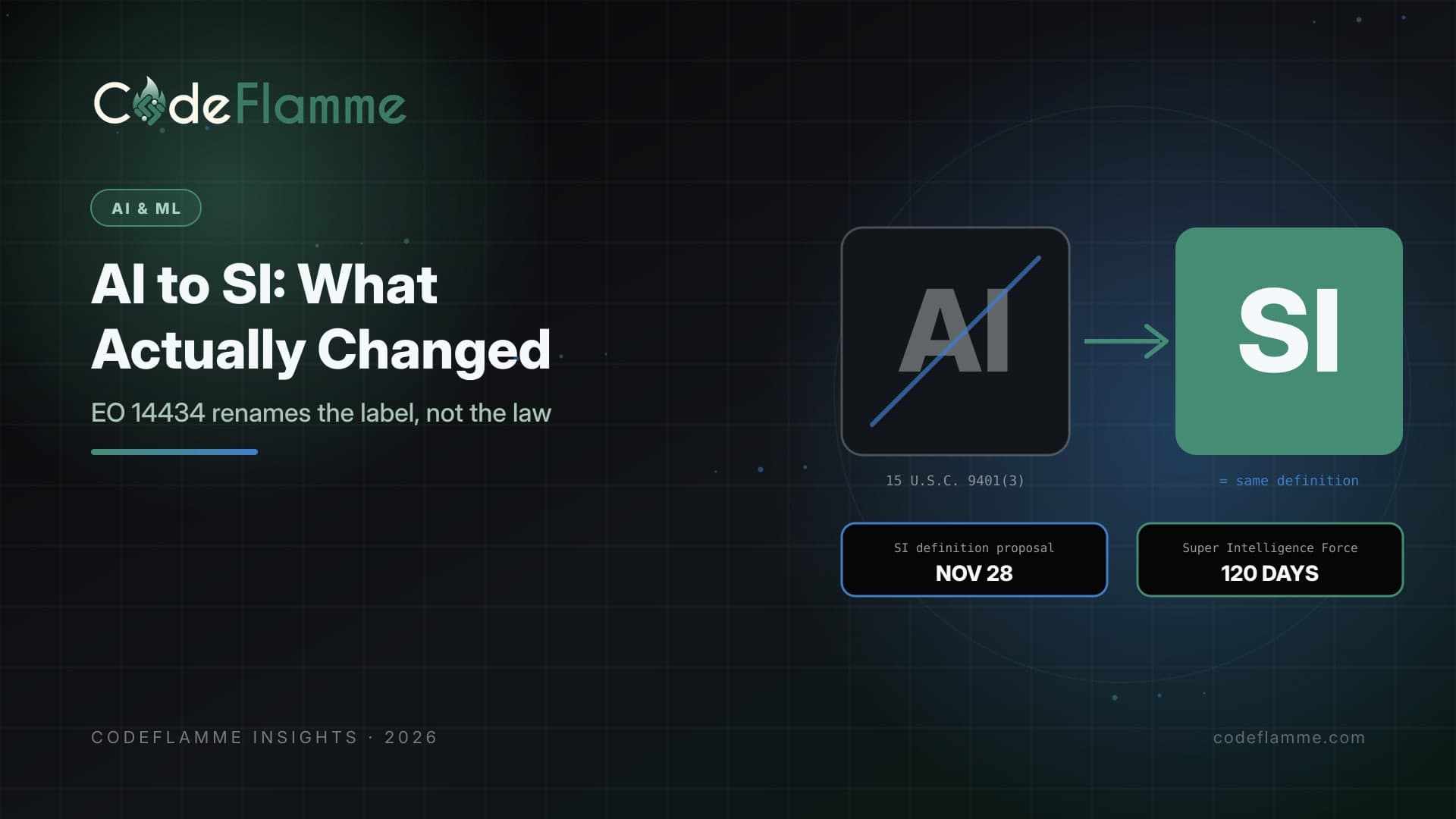
Read the text and the scope is narrow. Section 2 applies to the executive branch's own non-statutory documents. It explicitly does not require changing previously issued regulations, Presidential actions, contracts, grants, or historical documents. Section 3 defines "Super Intelligence" and "SI" as exactly the systems already covered by the statutory definition of artificial intelligence in 15 U.S.C. 9401(3). And Section 4 says the order creates no enforceable rights. So for now, SI is a new name for the same legal category. A chatbot, a recommendation model, and a frontier model all sit in the same bucket they sat in on September 28. Nothing about your product's legal classification moved.
The date that could make it more than a label
Section 3(b) is the part to put on the calendar. Within 60 days of the order, the President's science adviser must submit proposed legislative language for a federal definition of SI, including whether it should "modify, expand upon, or otherwise supersede" the existing statutory definition of AI and what conforming amendments would follow. Sixty days from September 29 lands on November 28, 2026. That is a proposal to the President, not law. A new definition would only take effect through later Presidential action consistent with law or an Act of Congress. But if the proposal narrows SI toward frontier-scale systems, or broadens it, every statute and procurement rule that references "artificial intelligence" becomes a question. That is where vendor obligations could actually shift.
The substance is governance, not vocabulary
The rename arrived alongside two moves that matter more for B2B builders. First, the same day, leaders including Sundar Pichai, Dario Amodei, Mark Zuckerberg, Greg Brockman, Elon Musk, and Jensen Huang signed a voluntary White House Accord on Super Intelligence. TechRadar describes the commitments as internal model evaluations, independent external audits, and board-level oversight. Second, the White House created a "Super Intelligence Force" led by Director of National Intelligence Jay Clayton, with 120 days to recommend how the federal government should oversee AI. According to the charter POLITICO published on October 6 , the vice chairs include FTC Chairman Andrew Ferguson, and the group has broad authority to examine threats to national security and civil liberties. TechRadar reports its remit includes reviewing how AI companies report breaches and hacks. Translate that into roadmap language: evaluations, audits, and incident reporting are where the expectations are heading. Those land on model labs first. They reach application vendors through procurement questionnaires, enterprise security reviews, and contract clauses, usually faster than anyone expects.
What's hype
"Superintelligence" already meant something before September 29: a hypothetical system that significantly exceeds human capability across most domains. PolitiFact points out that the government's SI is defined as today's AI, while the industry's superintelligence is something that does not exist yet. Calling a model SI does not make it more capable. The market has noticed the gap. The San Francisco Standard reported that the leaders of Google, OpenAI, and Anthropic did not say "SI" at the White House press event, and that the leading labs have not relabeled their models. The Washington Examiner reported on October 4 that Anthropic, OpenAI, Google, Meta, SpaceXAI, and Nvidia would not say whether they plan to adopt the new terminology. Musk did say on X that SpaceXAI would become SpaceXSI. California went the other way: on September 30 the governor signed an executive order telling state agencies to keep saying "AI." If the companies building frontier models are not putting SI on their products, a SaaS team relabeling a summarization feature as "superintelligent" is inviting a credibility problem, and possibly a claims problem. Capability claims in marketing still have to be true.
Five practical moves for SaaS and product teams
1. Add a glossary line, not a rebrand. If you sell to US federal agencies, expect RFPs, statements of work, and agency web content to say SI. Keep your product copy as is, and add one line to proposals and security docs: "SI as used in EO 14434 refers to systems within 15 U.S.C. 9401(3); our AI features fall within that definition." Keeping the terms mapped stops reviewers from treating a renamed question as a new requirement. 2. Leave contracts alone, but tag them. The order exempts existing contracts and grants. Tag every agreement and DPA clause that defines "AI" or "artificial intelligence" so that if a new federal definition passes, your legal review takes an afternoon instead of a quarter. 3. Make your evaluation evidence exportable. The accord's language is evaluations, audits, and oversight. Enterprise buyers will copy that into questionnaires. Keep a versioned record of which models you call, which evals you run before shipping a prompt or model change, and who signs off. 4. Write the AI incident runbook now. The task force is reviewing how breaches and hacks get reported. Decide what counts as an AI incident in your product (prompt injection that leaks tenant data, an agent acting outside its permissions, a wrong high-stakes output), who triages it, and how fast customers hear about it. 5. Keep two vocabularies for two jurisdictions. The EU AI Act, California, and most enterprise policies still say "AI." Federal agencies will say "SI." Your docs only need to be consistent internally and mapped externally.
AI -> SI readiness checklist (Oct 2026)
[ ] Product copy unchanged; no "superintelligent" capability claims
[ ] Glossary line mapping SI (EO 14434) to 15 U.S.C. 9401(3) in proposals
[ ] Contracts/DPAs that define "AI" tagged for review
[ ] Model + eval change log exportable for security reviews
[ ] AI incident definition, owner, and customer notice window written down
[ ] Calendar: Nov 28, 2026 (proposed SI definition due)
[ ] Calendar: ~early Feb 2027 (Super Intelligence Force 120-day mark)
Founder takeaway
The AI-to-SI shift is a naming change today and a possible definition change after November 28. The rename is not the part that will hit your roadmap. The governance that came with it will: evaluations, audits, and incident reporting are becoming the questions buyers ask. Teams that can answer them with evidence will close deals faster, whatever the government calls the technology.