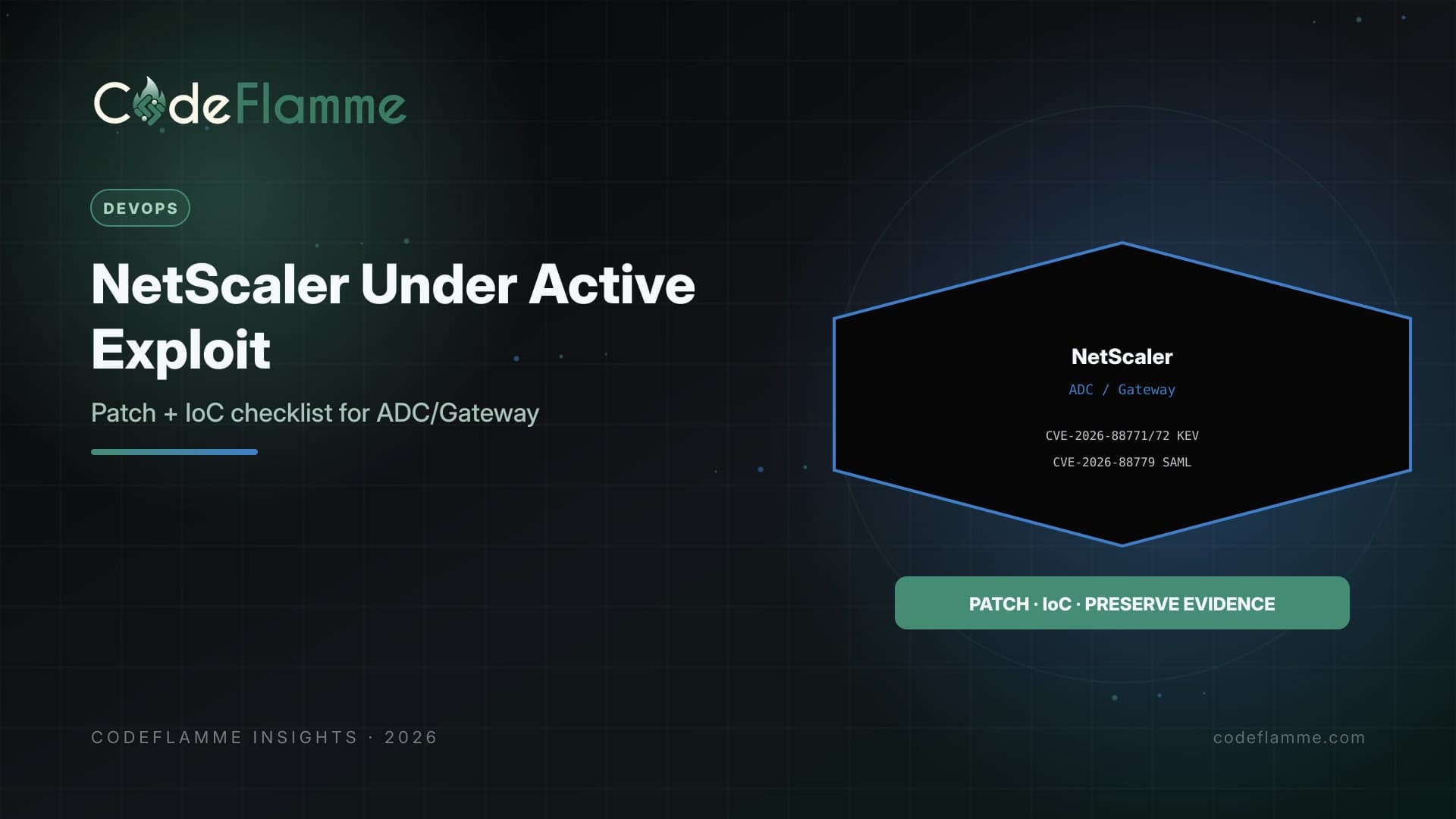
If your SaaS edge still terminates TLS or VPN on Citrix NetScaler ADC or Gateway, treat the last two weeks as an incident window, not a backlog ticket. On September 27, 2026, CISA amplified Citrix's disclosure of multiple NetScaler vulnerabilities and added CVE-2026-88771 and CVE-2026-88772 to the Known Exploited Vulnerabilities catalog — critical zero-days that can independently enable remote code execution, with confirmed global exploitation. On October 4, Citrix disclosed CVE-2026-88779 , a memory-overflow issue tied to SAML authentication with Gateway or AAA functionality; eSentire and others reported targeted attacks on unmitigated deployments, and CISA added it to KEV with a short federal remediation window.
What you are dealing with
CVE-2026-88771 / CVE-2026-88772. Critical RCE-class flaws on ADC/Gateway, actively exploited, listed in CISA KEV. Citrix published IoCs via NetScaler Console and a security bulletin spanning CVE-2026-88771 through CVE-2026-88778. CISA urges checking for compromise before patching when possible, and preserving forensic evidence because updates can erase visibility. CVE-2026-88779. CVSS 8.7 memory overflow requiring SAML SP or IdP configuration plus Gateway/AAA. Citrix observed targeted attacks. Public reporting has discussed DoS characterization with unconfirmed escalation to RCE via crafted authentication requests. Fixed builds (per eSentire's advisory summary) include ADC/Gateway 14.1-73.41+, 13.1-64.28+, and corresponding FIPS/NDcPP builds. Global Deny List signatures are available as temporary exposure reduction.
SaaS team checklist (next 48 hours)
1. Inventory. List every ADC/Gateway instance, version, whether Gateway/AAA and SAML ( samlAction / samlIdPProfile ) are configured, and who can approve downtime. 2. IoC pass before you wipe evidence. Use Citrix's NetScaler Console IoC guidance and CISA's SIGMA resources. Snapshot configs and relevant logs to offline storage. 3. Patch to fixed builds. Schedule maintenance windows; these appliances often need careful failover. Do not leave "we'll do it next quarter" on a KEV RCE. 4. Temporary controls. Apply Citrix Global Deny List signatures if patching slips hours, not as a substitute for weeks. 5. Credential and session hygiene. After suspected compromise, rotate secrets that traversed the appliance, review VPN/Gateway sessions, and inspect downstream app logs for anomalous admin access. 6. Customer communication. If NetScaler fronts customer traffic or partner VPN, prepare a factual status note: vulnerability class, patch status, and whether IoC review found anything.
NetScaler rapid triage
[ ] Version >= fixed build for 88771/88772 wave AND 88779
[ ] SAML SP/IdP + Gateway/AAA? If yes, 88779 in scope
[ ] IoC export saved offline BEFORE upgrade (if compromise suspected)
[ ] Global Deny List signatures applied as bridge
[ ] Management plane not exposed to open internet
[ ] Post-patch: session revoke, secret rotation, log review
[ ] Ticket linked to CISA KEV IDs for audit trail
Why product/engineering leaders own this
NetScaler often sits outside the "app repo" mental model, so product engineering assumes infra will handle it. Attackers do not care about your org chart. A compromised edge device is a path into admin VPNs, partner connections, and sometimes directly into production networks. Founders of SaaS companies running their own ADC should put this on the war-room channel the same way they would a critical Rails RCE.
Founder takeaway
Patch NetScaler ADC/Gateway for the September RCE KEVs and the October 4 SAML CVE-2026-88779 wave immediately, run IoCs before you destroy evidence, and treat deny-list signatures as a bridge only. Document versions and checks for customer trust reviews — KEV exploitation is exactly what security questionnaires are fishing for.
Detection and tabletop follow-through
After you patch, run a short tabletop: if IoCs had been positive, who isolates the appliance, who talks to customers, who engages IR, and how you validate that VPN identities were not abused? Write the answers down while the adrenaline is still useful. CISA's guidance to preserve evidence before updates is easy to skip when someone just wants the red banner gone. Review management-plane exposure. Many NetScaler incidents are worse because admin interfaces were reachable from broad networks. Restrict management to jump hosts, enforce MFA on admin paths, and monitor for configuration changes outside change windows.
If you rely on a managed service provider for ADC operations, demand written confirmation of versions and IoC results. "We usually patch monthly" is not an acceptable answer for KEV RCE. Put the CVE IDs in the ticket subject lines so auditors can trace response time later.
Operationally, treat this topic as a named owner problem: someone updates the runbook, someone verifies the deadline or launch assumptions against primary sources, and someone reports status in the weekly product meeting. Ambiguity is what turns a manageable change into a scramble. Write down the decision, the date you will re-check sources, and the customer-facing language you will use if asked before the next milestone.
Operationally, treat this topic as a named owner problem: someone updates the runbook, someone verifies the deadline or launch assumptions against primary sources, and someone reports status in the weekly product meeting. Ambiguity is what turns a manageable change into a scramble. Write down the decision, the date you will re-check sources, and the customer-facing language you will use if asked before the next milestone.
Operationally, treat this topic as a named owner problem: someone updates the runbook, someone verifies the deadline or launch assumptions against primary sources, and someone reports status in the weekly product meeting. Ambiguity is what turns a manageable change into a scramble. Write down the decision, the date you will re-check sources, and the customer-facing language you will use if asked before the next milestone.