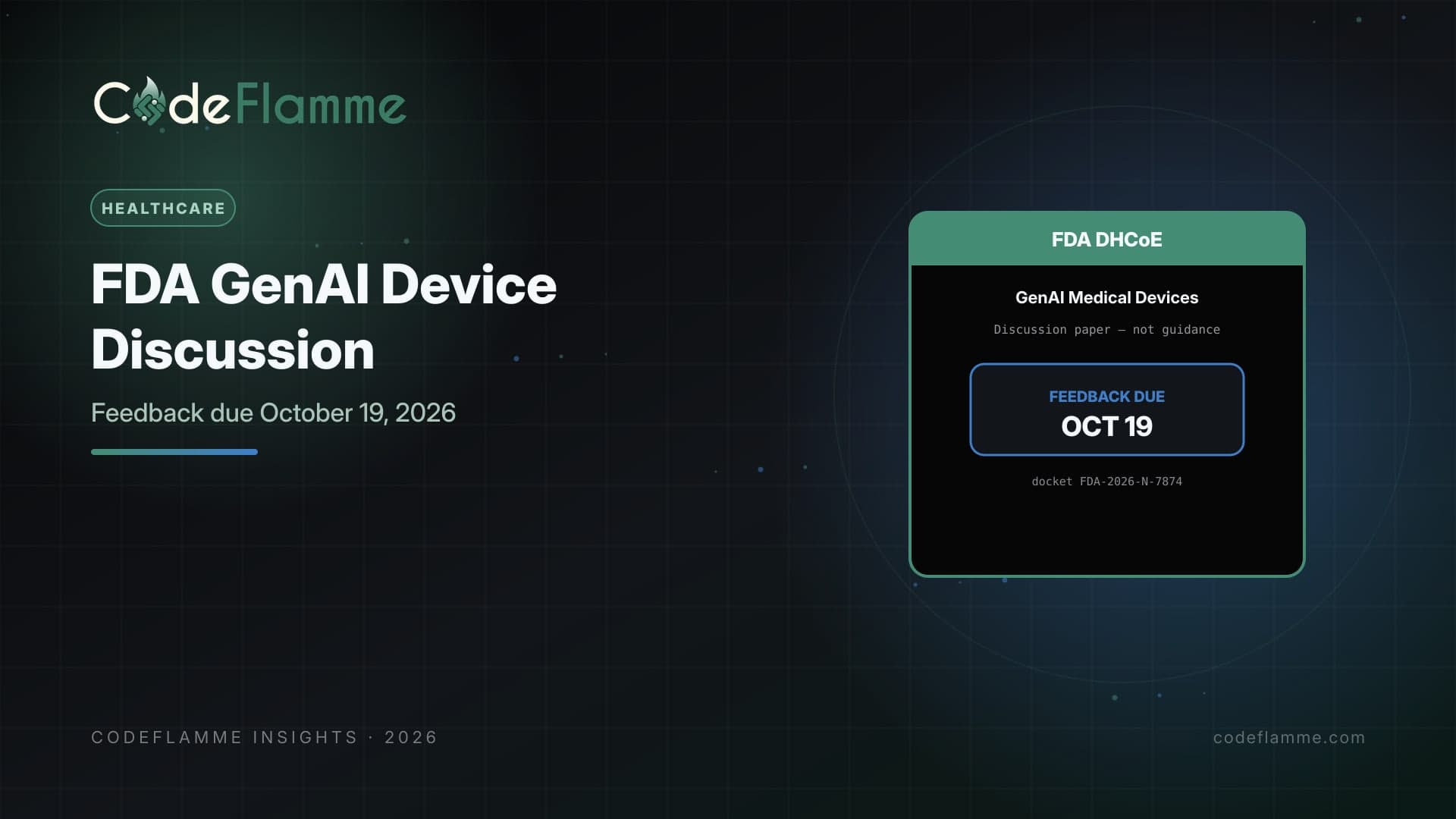
The FDA's Digital Health Center of Excellence (DHCoE) inside CDRH is running a discussion paper titled "Considerations for the Regulation of Generative AI-Enabled Medical Devices," with feedback due October 19, 2026 through Regulations.gov docket FDA-2026-N-7874 . If you are building clinical copilots, documentation assistants, imaging explainers, or any GenAI feature that could become a medical device, this is a near-term calendar item — not because it rewrites the rules tomorrow, but because early comments shape how hard the next decade of regulation will be to navigate.
Critical framing: discussion, not guidance
FDA is explicit: the paper is for discussion only. It does not represent draft or final guidance, does not propose or implement policy changes for how CDRH will regulate GenAI-enabled devices, and does not communicate proposed or final regulatory expectations for marketing submissions. It also does not settle whether approaches discussed sit inside existing legal authorities. Founders should not treat every question in the PDF as a new checklist item for their 510(k). They should treat it as a structured invitation to put real product evidence in front of the Agency.
What the paper covers
DHCoE organizes topics and questions around: risk assessment for GenAI-enabled medical devices; premarket evaluation considerations; postmarket monitoring; and other regulatory topics. You are not required to answer every question. Partial responses tied to your expertise are encouraged — which is ideal for startups that know one workflow deeply.
What founders should prepare before October 19
1. Map your intended use carefully. Separate wellness/education positioning from clinical decision support or device functions. Comments that blur those lines confuse the record. 2. Bring failure modes, not vibes. Hallucination, prompt injection, retrieval staleness, and silent model updates are concrete risks. Describe how you detect and contain them today. 3. Speak to evidence you can produce. Premarket questions will eventually become evidence expectations. Explain what evaluation harnesses, clinician review, and change-control you already run. 4. Address postmarket reality. GenAI products drift when models, prompts, or tools change. Describe monitoring, versioning, and rollback — even if informal today. 5. Coordinate counsel. Have regulatory counsel review anything that could be read as an admission about device status.
Comment packet outline (docket FDA-2026-N-7874)
- Who you are + product category (1 para)
- Intended use boundaries you currently draw
- Top 3 GenAI-specific risks you see in your workflow
- Premarket evidence you believe is feasible for startups
- Postmarket monitoring practices that scale without crushing seed teams
- Optional: answers to specific paper questions you can evidence
Deadline: 2026-10-19 on Regulations.gov
Why submitting is worth a week of founder time
Large incumbents will comment. If only they do, the eventual framework will optimize for their documentation machines. Early-stage healthtech needs the docket to reflect iterative model updates, limited clinical sites, and cloud-vendor dependencies. A short, precise comment from a shipping team can matter more than a generic industry letter.
Founder takeaway
Read the DHCoE discussion paper, remember it is not guidance, and submit focused feedback to FDA-2026-N-7874 by October 19, 2026. Bring intended-use clarity, real GenAI failure modes, and monitoring practices — not hype. Then keep building against today's actual regulatory pathways while you watch how the conversation evolves.
After you submit: operating while the story evolves
Once comments are in, return to today's pathways: intended use, Q-submission strategy if appropriate, quality system habits, and clinical evidence plans that do not assume the discussion paper is tomorrow's guidance. Track the docket for other comments from professional societies and large vendors so you are not surprised by emerging consensus. Inside the company, run a one-hour readout for product, clinical, and engineering: which questions FDA asked, what you answered, and which internal gaps the exercise exposed. Often the highest value of commenting is forcing your own team to write down risk controls that were previously tribal knowledge.
If October 19 is too close for a polished legal-reviewed letter, submit a shorter scoped comment rather than silence. FDA invited partial responses. A precise two-page note on postmarket monitoring for prompt-and-model changes beats a late novel.
Operationally, treat this topic as a named owner problem: someone updates the runbook, someone verifies the deadline or launch assumptions against primary sources, and someone reports status in the weekly product meeting. Ambiguity is what turns a manageable change into a scramble. Write down the decision, the date you will re-check sources, and the customer-facing language you will use if asked before the next milestone.
Operationally, treat this topic as a named owner problem: someone updates the runbook, someone verifies the deadline or launch assumptions against primary sources, and someone reports status in the weekly product meeting. Ambiguity is what turns a manageable change into a scramble. Write down the decision, the date you will re-check sources, and the customer-facing language you will use if asked before the next milestone.
Operationally, treat this topic as a named owner problem: someone updates the runbook, someone verifies the deadline or launch assumptions against primary sources, and someone reports status in the weekly product meeting. Ambiguity is what turns a manageable change into a scramble. Write down the decision, the date you will re-check sources, and the customer-facing language you will use if asked before the next milestone.
Operationally, treat this topic as a named owner problem: someone updates the runbook, someone verifies the deadline or launch assumptions against primary sources, and someone reports status in the weekly product meeting. Ambiguity is what turns a manageable change into a scramble. Write down the decision, the date you will re-check sources, and the customer-facing language you will use if asked before the next milestone.