Flutter 3.50 shipped on November 11, 2026, alongside Dart 3.14. The official release post leads with direct native interop going stable, but the parts most product teams will feel first are quieter: the bundled Material and Cupertino libraries are now formally deprecated, the CocoaPods fallback on iOS is winding down, Android release builds stop trusting certain Intent extras, and the old JavaScript interop libraries on web are deprecated. None of this breaks a shipped app overnight, but it changes what your next upgrades cost. Here is the Flutter 3.50 upgrade plan we would give a founder.
What actually changed in Flutter 3.50
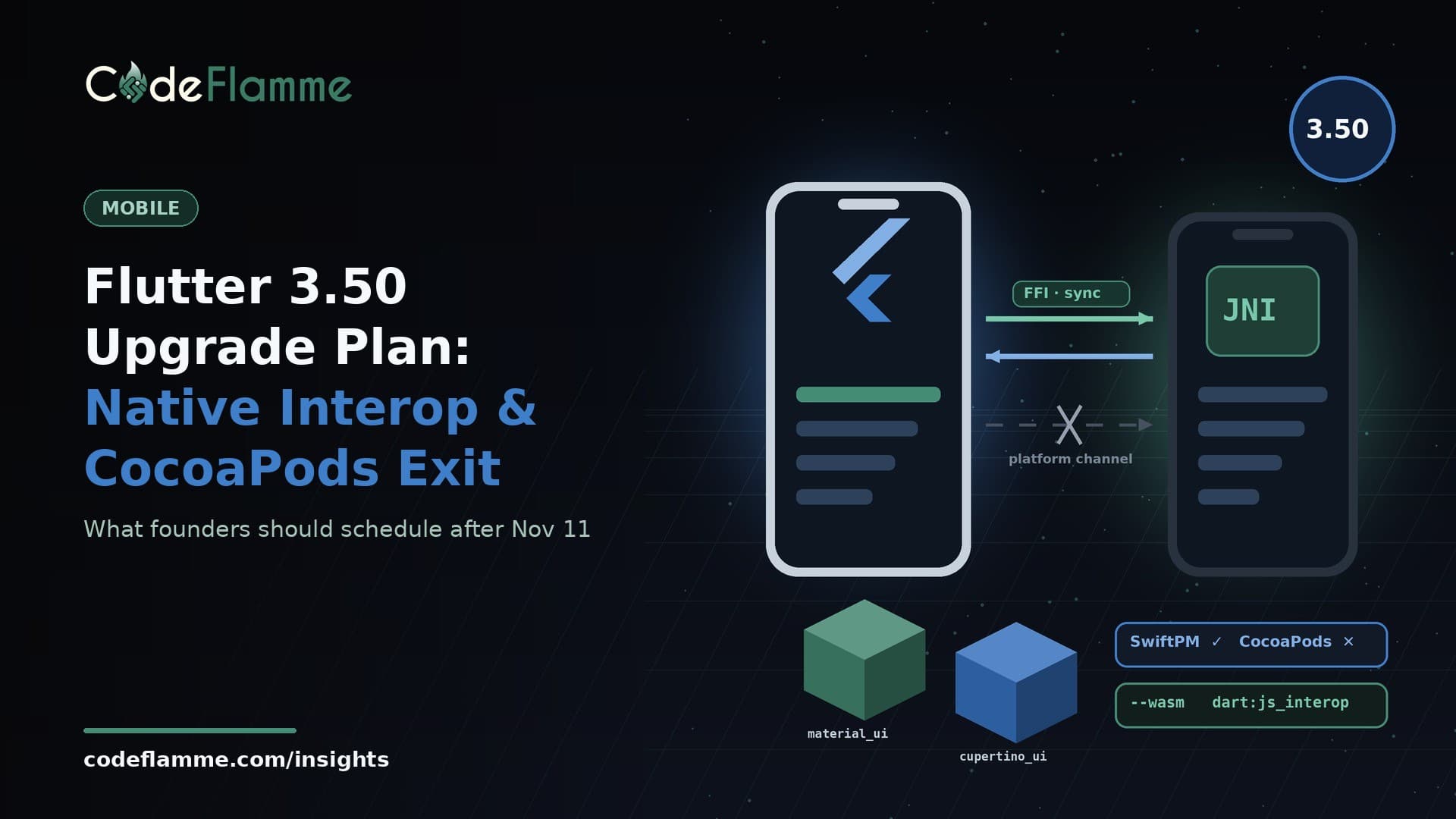
Direct native interop is stable. FFIgen for Objective-C and JNIgen for Java and Kotlin are now stable, joining FFIgen for C. Apps and plugins can call native APIs without platform-channel message passing, including synchronously and from background isolates. Material and Cupertino are deprecated in the SDK. package:flutter/material.dart and package:flutter/cupertino.dart are formally deprecated, and flutter create now starts new projects on material_ui . CocoaPods is on its way out. Turning off Swift Package Manager now prints a warning on every Flutter CLI command, and Flutter says a future release will remove the opt-out. Android Intent hardening. Release builds ignore route , dart_entrypoint and cached_engine_id values passed in external Intent extras. Standard deep linking keeps working. Legacy web interop is deprecated. dart:html , dart:js , dart:js_util and package:js are deprecated in favour of dart:js_interop and package:web .
1. This sprint: move to material_ui and cupertino_ui
If you followed our earlier guide on migrating to material_ui and cupertino_ui , 3.50 is the release that guide was preparing you for. If you have not migrated yet, the tooling does most of the work: the Flutter team documents dart fix --apply --code=migrate_design_widgets to rewrite imports and localization delegates. Budget the real time for review, not the command. Check custom themes, any code that extends Material widgets, and the packages you depend on, because a package that still imports the bundled libraries will keep producing deprecation warnings in your build.
2. Before December: re-enable Swift Package Manager on iOS
The Flutter release post ties this to a date: CocoaPods trunk is becoming read-only in December 2026, following the plan the CocoaPods maintainers published . Flutter has kept a CocoaPods fallback while the ecosystem moved, and 3.50 starts warning loudly if you disable Swift Package Manager. If someone on your team turned it off months ago to get a build passing, turn it back on now and fix the underlying issue while you still can choose when. React Native teams are making the same move, which we covered in the React Native 0.89 CocoaPods exit plan . Two related iOS notes. Flutter 3.50 is the first stable release since Xcode 27 and iOS 27 shipped, and it fixes intermittent launch crashes when running on iOS 27 devices. Flutter also warns when you build on an Intel Mac, and says a future release will require Apple Silicon, so budget for any Intel CI runners or laptops. Apple's own April 2027 iOS 27 SDK deadline makes this a 2027 problem either way.
3. Android: check deep links and plugin builds
The Intent change closes a real hole. Before 3.50, a Flutter app on Android accepted runtime configuration extras from any other app on the device. Release builds now ignore those values and reject engine flags passed that way. Normal deep links are unaffected, but if your app relied on passing a route through Intent extras from another app, a notification or an internal tool, test those flows on a release build before you ship. Plugin maintenance is the other Android line. Flutter says plugins that still apply the Kotlin Gradle Plugin manually will get lower pub.dev scores and will fail to build under AGP 10, and new projects created on 3.50 default to AGP 9.3.1, Gradle 9.5.0 and Java 17. If you maintain in-house plugins, migrate them to AGP's Built-in Kotlin now. If you depend on a third-party plugin that has not moved, that is a dependency risk worth tracking, the same way we suggested auditing rendering in the Impeller opt-out deprecation .
4. Flutter web: run the legacy interop check
If you ship Flutter on the web, add --no-deprecated-js-interop to a CI build. Flutter documents that it fails the build if your app or any package still depends on the legacy browser libraries, which tells you how much migration work you have before those libraries are removed in a future Dart release. Clearing it is also the prerequisite for WebAssembly builds. Flutter reports more than double the frame rate of JavaScript on heavy widget benchmarks in Safari 26.2+ and Firefox 147+, as an opt-in today through wasmAllowList .
5. Later: native interop, when it pays for itself
Stable direct native interop is the headline, and for some products it matters: apps that call native APIs on hot paths, need synchronous calls, or do native work from background isolates. Pigeon v30.0+ can now generate bindings that use FFIgen and JNIgen under the hood, but the Flutter team describes that mode as a preview and it supports only Android, iOS and macOS today, according to the native interop announcement . Our advice: do not rewrite working platform channels just because a faster option exists. Use direct interop for new native integrations, and migrate an existing channel only when profiling shows it is a real bottleneck.
A simple upgrade order
Upgrade a branch to Flutter 3.50 and run the full test suite on real iOS and Android devices. Run the migrate_design_widgets fix and review the diff. Re-enable Swift Package Manager everywhere, including CI. Test deep links and any Intent-driven flows on a release build. For web, add the legacy interop check to CI and log what fails. Schedule plugin, Intel Mac and native interop work as separate, smaller tickets.
Founder takeaway
Flutter 3.50 is a "clear the old paths" release. Most of the work is small if you do it now and expensive if you wait until a future release removes the fallbacks. Treat this sprint as the time to migrate design packages and re-enable Swift Package Manager, then plan the rest. If you are still weighing frameworks for a new product, start with React Native vs Flutter in 2026 . If you want help planning or running a Flutter 3.50 upgrade on a live app, talk to our team or see our mobile app development services .