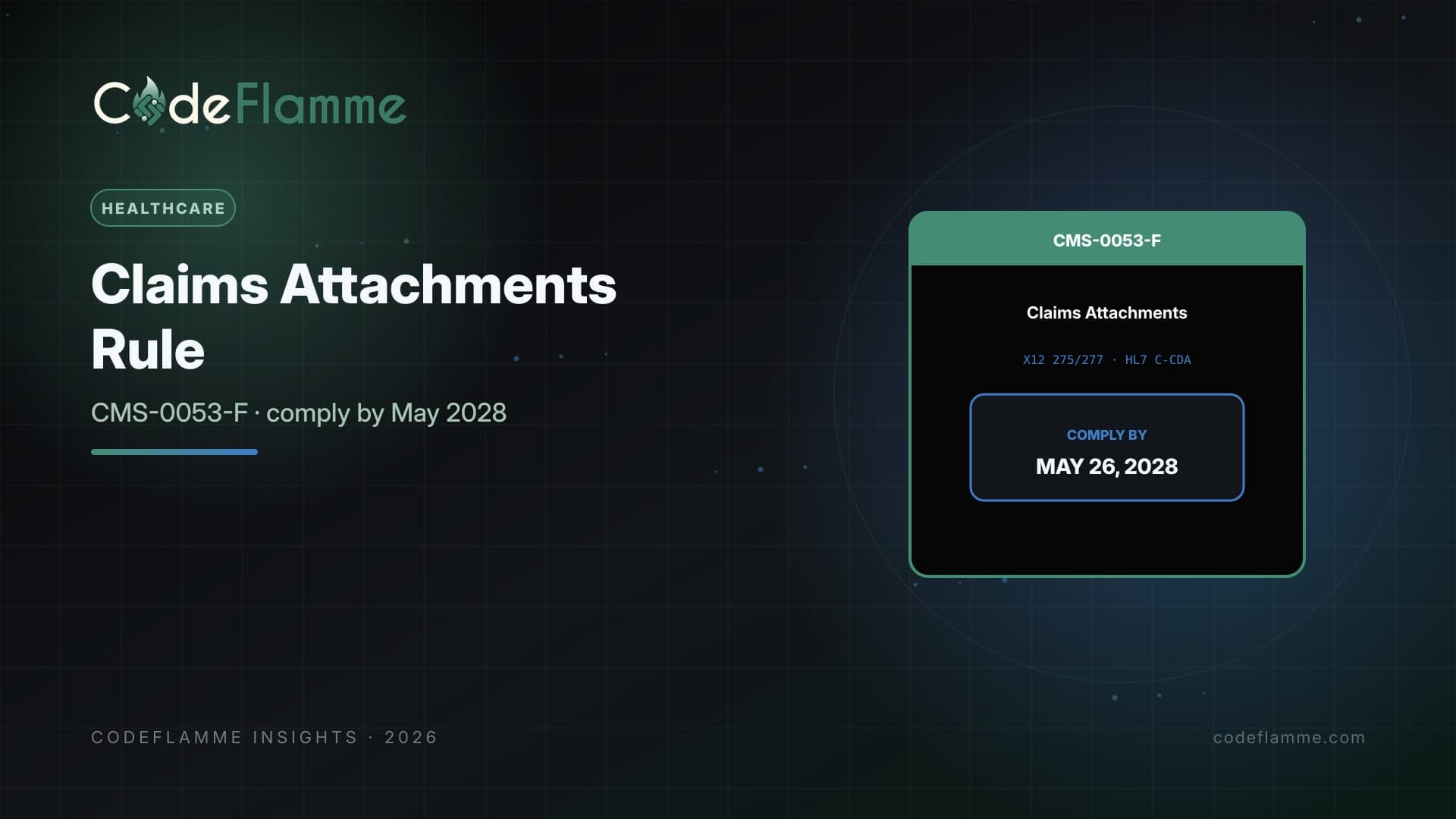
On March 24, 2026, HHS/CMS published the Administrative Simplification final rule CMS-0053-F adopting standards for health care claims attachments transactions and electronic signatures. CMS fact sheets and the NSG FAQ state the rule is effective May 26, 2026, and covered entities must comply by May 26, 2028. It applies to HIPAA-covered entities that conduct these electronic transactions — health plans, providers, and clearinghouses — and centers on standardized X12 attachment transactions (commonly discussed as 275/277 attachment flows) with HL7 C-CDA / Attachments Implementation Guide document formats, plus compliant electronic signatures when used. CMS materials emphasize claims attachments, not prior authorization. May 2028 sounds distant. For a healthtech vendor selling into payers or provider systems, two summers is one major platform cycle. Waiting until 2027 to learn C-CDA attachment profiles is how implementations slip into emergency RFPs. If you are earlier in the journey, start with our guide to building healthtech MVPs without getting burned by compliance .
What to build in product terms
Attachment transport. Support or integrate the standardized X12 attachment request/response transactions your clearinghouse partners will require — do not invent a proprietary PDF email workflow and call it "HIPAA ready." Document payload. Plan HL7 C-CDA-based clinical document generation and validation against the Attachments IG profiles your customers name. Budget clinical informatics time; this is not a weekend XML dump. Signature path. If your product captures electronic signatures on attachment packages, map them to the rule's signature standard expectations with counsel and your HITRUST/SOC narratives. Auditability. Store who requested which attachment, which document version left the system, and acknowledgment status. Payer denials will dispute missing documentation; your logs are the product.
Roadmap milestones that keep founders honest
2026 H2: requirements workshop with a design partner payer/clearinghouse; pick IG versions; spike C-CDA generation for your top three attachment types (op notes, imaging reports, medical necessity letters — whatever your niche actually sends). 2027 H1: end-to-end pilot through a clearinghouse in non-prod; measure turnaround and rejection reasons. 2027 H2: production feature flag for early adopters; train support on attachment status UX. 2028 Q1: compliance evidence pack for customer security questionnaires referencing CMS-0053-F. If you only sell analytics and never touch claims workflows, document that boundary so sales stops over-promising "attachments ready" in RFPs.
CMS-0053-F vendor checklist (effective 2026-05-26 / comply 2028-05-26)
[ ] Confirm whether your product participates in claims attachment transactions
[ ] Clearinghouse / X12 275-277 pathway identified
[ ] HL7 C-CDA Attachments IG profiles selected for top document types
[ ] E-signature approach reviewed with counsel if used
[ ] Audit log: request, document version, ack, resubmit
[ ] Customer RFP language aligned to real scope (no vapor)
Founder takeaway
CMS-0053-F makes standardized claims attachments a dated compliance project: effective May 26, 2026, comply by May 26, 2028. Healthtech vendors in the claims documentation path should start X12 + HL7 C-CDA work now, pilot with a clearinghouse in 2027, and stop treating PDF-over-email as a strategy. Build the audit trail your buyers will demand when attachments become table stakes.
Where startups get the scope wrong
Some teams assume "we store PDFs" equals attachments compliance. CMS-0053-F is about standardized transactions and document formats between covered entities — not merely encrypting a blob store. Conversely, pure clinical decision support that never participates in claims attachment exchange may be out of scope; over-building wastes runway. Map your data flows with a compliance advisor before you hire three HL7 consultants. Prior authorization is explicitly called out in CMS FAQ materials as outside this particular attachments rule. Do not merge prior-auth roadmap slides into CMS-0053-F delivery plans just because both involve payer documentation; the prior authorization API work has its own clock, which we covered in prior authorization APIs due January 2027 .
Clearinghouse relationships are strategic. If you lack one, budget partnership time. Test rejection codes early; attachment failures are operationally expensive when cash collection depends on them.
Security and privacy alongside standards
C-CDA packages contain sensitive clinical detail. Apply minimum-necessary access in your UI, encrypt at rest, and log views. Electronic signature flows need tamper-evident storage. Align BAAs with any new subprocessors that validate or transform documents.
Invest in customer education content now. Provider ops teams will ask vendors for timelines; a clear public FAQ citing CMS-0053-F effective and compliance dates positions you as the adult in the RFP room.
What to do in the next two weeks
Put an owner on the checklist in this article, schedule the verification work, and write down what "done" means in your ticketing system. Share the primary-source links with security and counsel so debates start from the vendor or regulator text, not from a slide paraphrase. If you need external help, bring them the inventory — which document types you send, which clearinghouses you use, and where signatures are captured — not a blank calendar invite.
Close the loop with a short internal note: what changed, what remains open, and which customer communications went out. That note becomes the seed of your next audit response and keeps the organization from relearning the same lesson when the next payer standard lands.
Interoperability testing mindset
Budget negative tests: truncated C-CDA, wrong document type codes, signature missing when required, and duplicate attachment ids. Payer systems are unforgiving. Automate schema validation in CI so a well-meaning content change cannot ship an invalid clinical document. Keep a golden set of anonymized sample packages for regression — never production PHI in CI. If you serve both US HIPAA markets and other regions, isolate code paths; do not let EU document features accidentally weaken HIPAA controls or vice versa.
Sales enablement should carry a one-pager that cites the Federal Register rule id, the May 26, 2026 effective date, and the May 26, 2028 compliance date, then lists exactly which attachment document types your product will support in v1 versus later. Over-promising "all attachments" creates delivery trapdoors. Under-promising with a clear niche (for example imaging-heavy specialties) wins trust and keeps engineering focused.