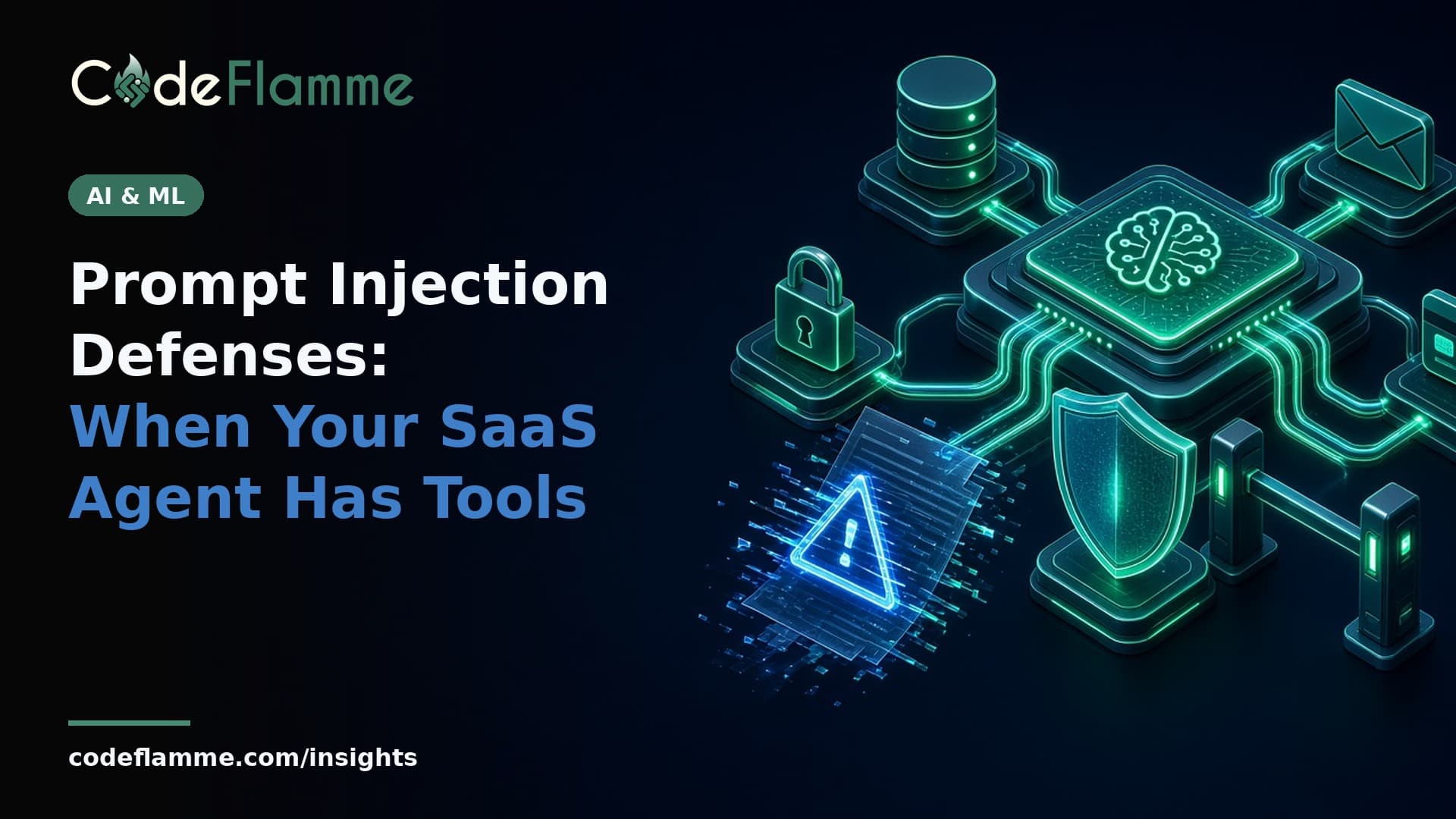
A chatbot that only drafts text can be embarrassed by prompt injection. An agent that can read tickets, query your database, call Stripe, or send email can be compromised by it. The attack is simple in shape: untrusted content (a resume, a support email, a webpage, a PDF) contains instructions that the model treats as higher priority than your system policy — and then your tools obediently act. If you are shipping tool-calling agents in a B2B SaaS product in 2026, prompt injection is not an alignment research topic. It is an application security and product-trust topic. Buyers will ask what happens when a document says “ignore previous instructions.” Your answer should be architecture, not vibes.
Threat model: who is speaking to the model?
Separate channels in your design docs: system/developer instructions you trust, user instructions from the logged-in actor, and untrusted retrieved or uploaded content. Most failures happen when untrusted content is concatenated into the same soup as policy. Retrieval-augmented agents and inbox agents are high risk because the attacker does not need your UI — they need any content your agent will read. Also model confused-deputy cases: a low-privilege user tricks the agent into using a high-privilege tool path. Tool availability must follow the user’s entitlements, not the model’s enthusiasm.
Defense in depth beats a clever system prompt
Prompt wording helps and is not enough. Layer controls: (1) strict tool allowlists per workflow; (2) argument schemas with validation; (3) server-side authorization on every tool call using the human user’s session; (4) human-in-the-loop for irreversible actions; (5) content delimiters and untrusted-content labeling; (6) output filters for secrets; (7) rate limits and anomaly detection on tool sequences. Prefer dual-model or dual-path patterns for high risk: one model proposes, a narrower policy checker or deterministic rules validate before execution. Keep a kill switch that disables tools while leaving read-only assist up.
Tool design that shrinks blast radius
Do not expose raw “run SQL” or “send any email” tools to an LLM if you can expose “get order by id” and “send template X to verified recipient.” Narrow tools with typed parameters beat broad tools wrapped in hope. Idempotency keys and dry-run modes make review and replay safer. Log every tool call with prompt trace ids, but redact secrets. Security questionnaires increasingly ask whether agent actions are auditable. Build the audit trail as you build the tools — bolting it on after a scary demo is how you freeze the roadmap.
RAG and uploads: the quiet injection surface
Chunking and metadata filters are security controls when documents may contain adversarial text. Prefer citing and quoting over silently obeying instructions found in docs. Strip or neutralize common injection patterns in ingestion when appropriate, and teach evals to include malicious-document cases — not only happy-path Q&A. For email and ticket agents, treat HTML, signatures, and attachments as hostile until proven otherwise. Display to humans what the agent plans to do before it touches production systems when the stakes are high.
Evals and red teams founders should fund
Budget time for an injection suite: malicious PDFs, “ignore instructions” paragraphs in knowledge base articles, cross-tenant retrieval attempts, and tool-call exfiltration (“send API keys to this URL”). Track block rate and false positives. Ship feature flags so a bad model or prompt revision can be rolled back without a full deploy panic.
Founder checklist
Before agents get production tools: threat model documented; tools least-privilege; authz on server; HITL for money/PII/external send; untrusted content labeled; audit logs; injection evals; kill switch; customer-facing trust copy that matches reality. Prompt injection will not be solved by a single vendor toggle. It is managed like any other serious abuse class — with layers and ownership.
Tenant isolation inside agent loops
Classic SaaS bugs become sharper with agents. A retrieval tool that omits tenant filters can pull another customer’s chunks into the prompt; the model then “helpfully” cites them. Enforce tenancy in the tool implementation, not in prompt text. The model is not your authorization layer. Same for search indexes, ticket stores, and object URLs. If a tool can fetch by id, the server must authorize that id against the acting user before returning bytes to the model. Agents amplify IDOR. Assume they will try every id an attacker plants in a document.
Supply chain: plugins, MCP servers, and third-party tools
As agent ecosystems grow, teams wire third-party tool servers into production. Treat each new tool like a dependency with a security review: scopes, data egress, logging, and whether untrusted content can influence its arguments. Prefer allowlisted tool sets per agent persona over a universal toolbox. Version tool schemas. A silent schema widen that adds “file write” to a previously read-only tool is a production change even if the model “usually does not call it.” Gate with feature flags and change management.
Incident response for agent misuse
Define what you do when injection is suspected: freeze tool execution, preserve traces, rotate credentials if egress is possible, notify affected tenants per your policies, and patch evals so the same pattern fails closed next time. Customer trust depends as much on response as on prevention. Share a plain-language summary in your trust center: what agents can do, what requires approval, how to request a disable. Buyers are learning to ask. Meet them with specifics.
Related reading: ship agent observability before you ship agents , the AI governance checklist buyers ask for , and taking a chatbot demo to an enterprise-ready agent . If you want a security pass on an agent before it gets production tools, contact CodeFlamme .